TRANS-CANADA HIGHWAY TWINNING

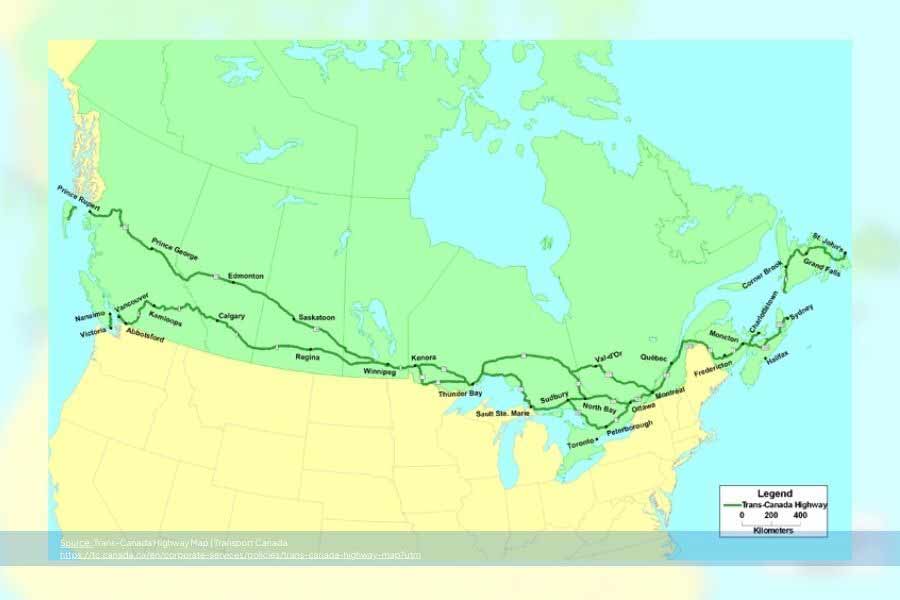
Trans-Canada Highway Twinning Programme
Multiple provinces are progressively twinning segments of the Trans-Canada Highway to address capacity constraints and improve road safety. Active twinning programmes are concentrated in British Columbia, Ontario, Manitoba and Newfoundland and Labrador. Saskatchewan and Alberta have completed twinning of their main Trans-Canada segments, and Quebec has widened significant portions. Remaining two-lane segments cross the traditional territories and treaty lands of numerous First Nations, and Indigenous consent, consultation and partnership are central to project advancement in each jurisdiction.
Overview
The Trans-Canada Highway twinning programme is not a single integrated project. It comprises distinct provincial programmes, each at a different stage of development, coordinated between provincial governments and supported in part by federal funding. Combined investment across the active segments exceeds C$7 billion. Each segment operates under its own environmental assessment, procurement and Indigenous consultation framework.
Key Facts
| Category | Information |
| Location | Active segments in BC, Ontario, Manitoba and Newfoundland and Labrador |
| Proponents | Provincial transportation ministries with federal cost-sharing |
| Project type | Highway capacity expansion (two-lane to four-lane) |
| Combined investment |
Exceeds C$7 billion across active segments |
| Status | Varies by province and segment (see Development Stage below) |
| Indigenous framework | Territory-specific: unceded title, numbered treaties and modern claims |
Sources: Government of British Columbia; Government of Canada / Newfoundland and Labrador; Impact Assessment Agency of Canada, Ontario; Impact Assessment Agency of Canada, Manitoba
Development
British Columbia: Fraser Valley Highway 1 Corridor Improvement Programme
The Government of British Columbia is widening Highway 1 through the Fraser Valley from the 216th Street interchange in Langley toward Chilliwack. The programme is delivered in multiple phases. Phase 3A, covering 264th Street to Mount Lehman Road, has an approved budget of C$2.34 billion, with advance works and a C$286.2 million contract awarded to KEA Fraser Valley Connectors in 2024. Completion of Phase 3A is expected in 2029. Phase 3B, covering Mount Lehman Road to Highway 11 in Abbotsford, has a further approved budget of C$2.65 billion. Procurement for Phase 3B began in 2025, with major construction starting in 2026 and completion targeted for 2031. The 2025 BC Budget allocated approximately C$5 billion across both phases.
The corridor sits within the traditional territories of the Stó:lō people, including Matsqui First Nation, Kwantlen First Nation, Semá:th First Nation and other Stó:lō Nation member communities. The Ministry of Transportation has engaged with First Nations on design, environmental permitting and archaeological monitoring. Kwantlen First Nation has delivered advance clearing work on the corridor.
Sources: Government of British Columbia, August 2024; Government of British Columbia, November 2023; BC Trucking Association, Budget 2025; Associated Engineering
British Columbia: Highway 1 Kamloops to Alberta
The Government of British Columbia has been four-laning Highway 1 between Kamloops and the Alberta border. Seven sections have been delivered, with total programme costs exceeding C$1.6 billion across all sections. The final and most complex section, the Kicking Horse Canyon Phase 4, opened to full four-lane operation on 31 July 2024, at a cost of approximately C$601 million, with the federal government contributing C$215.19 million and the province C$385.58 million. Remaining sections between Kamloops and Revelstoke, including Chase (C$220 million), Salmon Arm West (C$155 million) and the Bruhn Bridge (C$224.5 million), are at various stages.
Sources: Government of British Columbia, Kicking Horse Canyon; Top100Projects; Kicking Horse Canyon Project
Ontario: Highway 17 Twinning (Kenora to Manitoba Border)
The Ontario Ministry of Transportation is widening a 40-kilometre stretch of Highway 17 (Trans-Canada) between the Manitoba/Ontario border and the Highway 17/17-A junction in Kenora. The project is being delivered in three sections: Section 1, from the Manitoba border to Highway 673 (6.5 kilometres); Section 2, from Highway 673 to Rush Bay Road (8.5 kilometres); and Section 3, from Rush Bay Road to Highway 17A (25 kilometres). Moncrief Construction of Kenora was awarded the Section 1 contract in March 2022, valued at approximately C$32 million, generating approximately 310 jobs. Section 1 was completed in 2024. In July 2025, the Kenora-Rainy River MPP confirmed that Section 2 construction activity was expected to begin in autumn 2025, with significant road construction to follow in spring 2026. Environmental assessment and route planning for Sections 2 and 3 remain underway.
Construction on this corridor began in January 2022. In September 2024, the Impact Assessment Agency of Canada confirmed that the project could not be designated for a federal impact assessment because it had substantially begun. In June 2026, the federal Minister of Environment, Climate Change and Nature decided that a regional assessment of the Trans-Canada Highway Improvement Project covering both the Ontario and Manitoba segments was not warranted.
Ontario is also investing approximately C$6.5 billion across northern roads, bridges and highways, including the completed widening of two sections of Highway 11/17 between Thunder Bay and Nipigon, announced in November 2025, widening of Highway 69 from Parry Sound to Sudbury, and a 2+1 highway pilot on Highway 11 north of North Bay scheduled to commence in 2026.
Sources: Impact Assessment Agency of Canada, Ontario project; Northern Ontario Business, March 2022; TBNewsWatch, March 2022; Kenora Online / CKDR, July 2025; Impact Assessment Agency of Canada, regional assessment decision; ReNew Canada, November 2025
Manitoba: Highway 1 Twinning (Falcon Lake to Ontario Border)
Manitoba Transportation and Infrastructure is proposing to construct two new lanes along a 16-kilometre stretch of the Trans-Canada Highway from approximately five kilometres west of Provincial Road 301 to the Manitoba/Ontario border, within Whiteshell Provincial Park (earlier reporting cited 17 kilometres for the broader Falcon Lake to border distance). Work on a 700-metre section nearest the Ontario border began in 2023 to align with Ontario's new four-lane highway. Manitoba committed over C$10 million for interim improvements along the existing highway. The province commissioned Tetra Tech Canada Inc. to complete a conceptual design study for the full 16-kilometre twinning. The proposed scope includes expanding the two-lane highway to four lanes, rebuilding or replacing two interchanges, upgrading access at Hunt Lake and Lyons Lake, and replacing the flyover of Provincial Road 301.
In June 2026, the President of the Impact Assessment Agency of Canada determined that the Manitoba twinning project did not warrant designation under the Impact Assessment Act. The separate request for a regional assessment covering both the Manitoba and Ontario corridors was also declined by the Minister on 30 June 2026.
Sources: Government of Manitoba, May 2023; Impact Assessment Agency of Canada, Manitoba designation; Impact Assessment Agency of Canada, regional assessment
Newfoundland and Labrador: TCH Twinning (Avalon and Central Regions)
In May 2023, the Governments of Canada and Newfoundland and Labrador announced a joint investment of up to C$306 million to twin segments of the Trans-Canada Highway, funded on a 50/50 cost-sharing basis under the Investing in Canada Infrastructure Program. The project covers a 15-kilometre section between Bishop's Falls and Grand Falls-Windsor in the Central region, and approximately 40 kilometres from Whitbourne heading west on the Avalon Peninsula. A proposed additional 20-kilometre extension on the Avalon has been paused pending a federal cost-sharing agreement for that portion.
In August 2025, a request for proposals was issued for a public-private partnership model. In December 2025, the incoming provincial government cancelled the P3 RFP and adopted a traditional procurement approach, dividing the work into multiple progressive contracts. Construction was anticipated to start in 2026.
Sources: Government of Canada / Newfoundland and Labrador, May 2023; Government of Newfoundland and Labrador, August 2025; Government of Newfoundland and Labrador, December 2025
Indigenous Participation
Ontario
The project area lies within Treaty 3 territory. In February 2020, Ontario signed a Memorandum of Understanding with the Niiwin Wendaanimok (Four Winds) Partnership, comprising Shoal Lake 40 First Nation, Washagamis Bay First Nation, Wauzhushk Onigum First Nation and Niisaachewan Anishinaabe First Nation. The signing took place at the Wauzhushk Onigum First Nation Youth and Elder Centre, preceded by a Manito Aki Inakonigaawin (Great Earth Law) ceremony. Ontario also engages with Iskatewizaagegan No. 39 Independent First Nation and the Métis Nation of Ontario. In April 2021, the four First Nations gave conditional consent to begin Phase 1 construction under their guidance. The Phase 1 construction contract included requirements to work with Indigenous partners. The Niiwin Wendaanimok Partnership stated that the first phase would generate an estimated total economic impact of C$77 million and the equivalent of 331 full-time jobs. Consent for Phases 2 and 3 remains pending as of mid-2026.
Sources: Ontario Ministry of Transportation / NationTalk, February 2020; Northern Ontario Business, April 2021; Northern Ontario Business, March 2022
Manitoba
The Whiteshell Provincial Park twinning corridor lies within Treaty 1 and Treaty 3 territories. Treaty 1 territory extends eastward to Whiteshell Provincial Park and includes Sagkeeng First Nation and Brokenhead Ojibway First Nation among others. Treaty 3 territory in Manitoba covers the southeastern corner of the province, including Buffalo Point First Nation. No specific Indigenous partnership agreement for the Manitoba twinning segment has been announced as of mid-2026.
Sources: Government of Manitoba, Treaty 1 statement; Southern Chiefs' Organization, Treaties
British Columbia
The Fraser Valley corridor sits within the unceded traditional territories of the Stó:lō people, including Matsqui, Kwantlen, Semá:th, Leq'a:mel and other First Nations. First Nations have been consulted on environmental permitting and have participated in archaeological monitoring. Kwantlen First Nation has delivered advance clearing work on the corridor.
Sources: Government of British Columbia, November 2023; Associated Engineering; Government of British Columbia, Fraser Valley programme update
Timeline
| Date |
Milestone |
| February 2020 | Ontario signs MOU with Niiwin Wendaanimok Partnership for Highway 17 twinning |
| April 2021 | Four First Nations give conditional consent to begin Ontario Phase 1 |
| March 2022 | Ontario awards Section 1 contract to Moncrief Construction |
| May 2023 | Canada and Newfoundland and Labrador announce C$306 million twinning investment |
| May 2023 | Manitoba announces next steps for Falcon Lake to Ontario border twinning |
| November 2023 | BC begins advance works on Fraser Valley Phase 3A |
| July 2024 | BC Kicking Horse Canyon Phase 4 opens to full four-lane operation |
| August 2024 | BC announces C$2.65 billion for Fraser Valley Phase 3B |
| 2024 | Ontario Section 1 (6.5 km, Manitoba border to Highway 673) completed |
| September 2024 | IAAC confirms Ontario twinning project cannot be designated under IAA |
| November 2025 | Ontario completes widening of two Highway 11/17 sections near Thunder Bay |
| December 2025 | Newfoundland cancels P3 RFP, adopts traditional procurement |
| 2026 | BC Fraser Valley Phase 3B major construction begins |
| 2026 | Newfoundland and Labrador construction anticipated to start |
| June 2026 | IAAC determines Manitoba twinning does not warrant designation |
| June 2026 | Federal Minister declines regional assessment for Ontario/Manitoba corridor |
| 2029 | BC Fraser Valley Phase 3A targeted completion |
| 2031 | BC Fraser Valley Phase 3B targeted completion |
Sources: As cited per segment above
Cost Summary
| Segment | Estimated cost |
| BC Fraser Valley Phase 3A (264th St to Mt Lehman Rd) | C$2.34 billion |
| BC Fraser Valley Phase 3B (Mt Lehman Rd to Highway 11) | C$2.65 billion |
| BC Kicking Horse Canyon Phase 4 | C$601 million |
| BC other Kamloops to Alberta sections (Chase, Salmon Arm, Bruhn Bridge, etc.) | C$1 billion+ |
| Ontario Highway 17 Section 1 (Kenora) | Approximately C$32 million |
| Ontario northern highways, total provincial investment | C$6.5 billion |
| Manitoba Highway 1 (Whiteshell, interim works) | C$10 million+ (interim); full twinning cost to be confirmed |
| Newfoundland and Labrador (Avalon and Central) | C$306 million |
Sources: As cited per segment above
Regulatory Status
No active federal impact assessment applies to any of the twinning segments. The Ontario project was found to have substantially begun and could not be designated under the amended Impact Assessment Act in September 2024. The Manitoba project did not warrant designation in June 2026. A request for a regional assessment covering the Ontario and Manitoba corridors was declined by the Minister on 30 June 2026. Each provincial segment operates under its respective provincial environmental assessment and planning framework.
Sources: IAAC, Ontario decision, September 2024; IAAC, Manitoba decision, June 2026; IAAC, regional assessment decision, June 2026
Investment Assessment
Twinning existing highway alignment carries lower development risk than new corridor construction, as the basic route, environmental parameters and land requirements are established. The segment-by-segment approach enables progressive advancement and localised risk management. Principal risk factors include multi-jurisdiction coordination across four provincial governments, varying Indigenous consultation and consent frameworks, provincial fiscal constraints affecting programme timing, and the pending consent of First Nations for remaining Ontario phases. The Ontario model, in which the Niiwin Wendaanimok Partnership gave conditional consent under a formal MOU framework, provides a structured template for Indigenous partnership on highway infrastructure. This framework has not yet been replicated in the Manitoba or Newfoundland segments.
Sources
- Government of British Columbia, Fraser Valley Highway 1 Corridor Improvement Programme
- Government of British Columbia, Highway 1 Kamloops to Alberta
- Government of British Columbia, Highway 1 investment announcement, August 2024
- Government of British Columbia, Highway 1 investment announcement, November 2023
- Government of Canada / Newfoundland and Labrador, TCH expansion, May 2023
- Government of Newfoundland and Labrador, RFP announcement, August 2025
- Government of Newfoundland and Labrador, traditional procurement, December 2025
- Government of Manitoba, Falcon Lake twinning, May 2023
- Government of Manitoba, Treaty 1 statement
- Impact Assessment Agency of Canada, Ontario twinning
- Impact Assessment Agency of Canada, Ontario decision, September 2024
- Impact Assessment Agency of Canada, Manitoba twinning
- Impact Assessment Agency of Canada, regional assessment decision
- Ontario Ministry of Transportation / NationTalk, Niiwin Wendaanimok MOU, February 2020
- Northern Ontario Business, Kenora First Nations conditional consent, April 2021
- Northern Ontario Business, Moncrief Construction contract, March 2022
- TBNewsWatch, Moncrief Construction contract value, March 2022
- Kenora Online / CKDR, Highway 17 Section 2 update, July 2025
- ReNew Canada, Highway 11/17 widening completion, November 2025
- Associated Engineering, Fraser Valley Highway 1
- BC Trucking Association, Budget 2025
- Kicking Horse Canyon Project
- Top100Projects, Highway 1 Kamloops to Alberta
- Southern Chiefs' Organization, Manitoba Treaties
---CS.jpg?width=352&name=ENERGY---NORTH-COAST-TRANSMISSION-LINE-(BC)---CS.jpg)
---CS.jpg?width=352&name=ENERGY---NORTHWEST-COAST-OIL-PIPELINE-(ALBERTA-TO-BC)---CS.jpg)
---CS-1PS.jpg?width=352&name=ENERGY---KSI-Lisims-lng-(nisgaa-nation%2c-bc)---CS-1PS.jpg)