BAY DU NORD (NEWFOUNDLAND & LABRADOR OFFSHORE)

Project Spotlight
Bay du Nord Offshore Oil Project
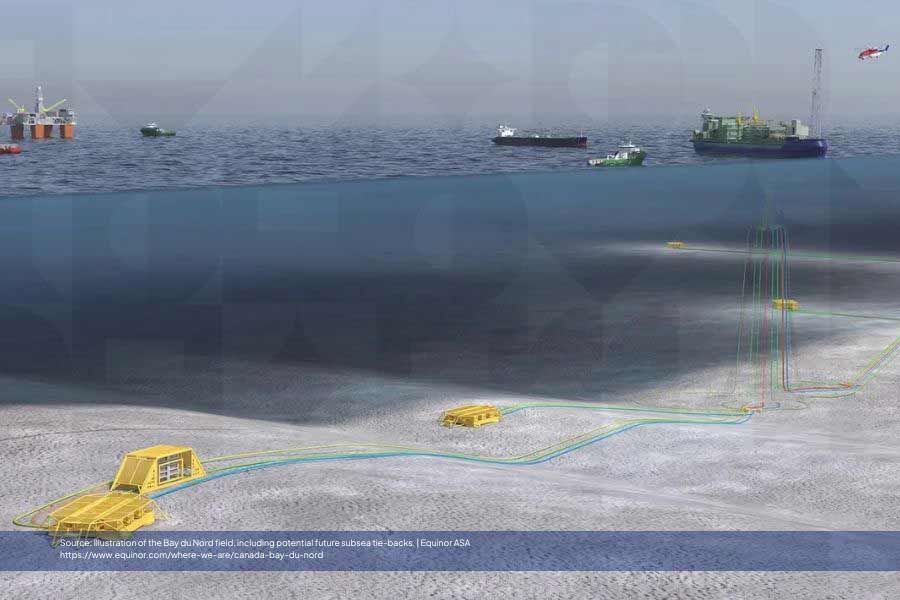
Bay du Nord is Canada's first deepwater offshore oil development, located in the Flemish Pass Basin approximately 500 kilometres east of St. John's, Newfoundland and Labrador. The project, estimated at approximately CAD $14 billion, will use a floating production, storage and offloading (FPSO) vessel to produce light crude oil from water depths of up to 1,170 metres.
Equinor, the Norwegian state majority-owned energy company, is the sole operator and holds 100 per cent ownership following its acquisition of BP's interest in July 2026. The federal government approved the project's environmental assessment on 6 April 2022, with the requirement that it achieve net-zero operational emissions by 2050. Project sanction is targeted for early 2027, with first oil expected in 2031.
Sources: Equinor; Government of Newfoundland and Labrador; Government of Canada
Overview
The initial phase of the Bay du Nord project covers the Bay du Nord and Cambriol discoveries, with estimated recoverable resources of approximately 430 million barrels. Additional discoveries in the Flemish Pass Basin, including Cappahayden, Harpoon and Baccalieu, present potential future tie-back opportunities, bringing broader resource potential to over one billion barrels.
The development concept is based on a phased subsea system tied back to a single FPSO vessel, designed for production of up to 160,000 barrels per day. The FPSO will feature a disconnectable turret system, extensive winterisation, and emissions reduction technologies including high-efficiency power generation, heat recovery, variable speed drives and a closed flare system. The crude is light oil (34° API gravity) discovered in Jurassic reservoirs.
Sources: Equinor; Government of Newfoundland and Labrador; Offshore Technology
Key Facts
| Category | Information |
| Location | Flemish Pass Basin, approximately 500 km east of St. John's, Newfoundland and Labrador |
| Proponent | Equinor (100% working interest) |
| Technology |
Floating production, storage and offloading (FPSO) vessel with subsea tiebacks |
| Production capacity | Up to 160,000 barrels per day |
| Recoverable resources (initial phase) | Approximately 430 million barrels |
| Broader resource potential | Over 1 billion barrels |
| Estimated value | Approximately CAD $14 billion |
| Water depth | Up to 1,170 metres |
| Status | FEED phase; Development Plan Application under regulatory review |
| Target FID | Early 2027 |
| First oil target | 2031 |
Sources: Equinor; Government of Newfoundland and Labrador; Offshore Technology
Development
Equinor (then Statoil) announced the Bay du Nord discovery in August 2013 following earlier discoveries at Harpoon in June 2013. Baccalieu was discovered in 2016, and further appraisal and exploration activity continued through 2020, including the Cambriol discovery. The original exploration partner was Husky Energy, whose interest passed to Cenovus Energy following the January 2021 Cenovus-Husky merger. In June 2022, BP acquired Cenovus's 35 per cent stake, and in July 2026, BP sold its interest to Equinor, giving Equinor sole ownership.
The federal environmental assessment was approved on 6 April 2022 with 137 legally binding conditions. Equinor paused the project in May 2023 citing volatile market conditions and cost inflation. Development activities resumed in January 2025 with pre-FEED contracts awarded to BW Offshore and Altera Infrastructure. In September 2025, BW Offshore was selected as preferred FPSO bidder. In March 2026, the Government of Newfoundland and Labrador signed a life-of-field benefits agreement with Equinor and BP. In April 2026, BW Offshore signed the FEED contract for the FPSO, and the Subsea Integration Alliance (Subsea7 and OneSubsea) was awarded the subsea FEED contract. On 5 May 2026, Equinor submitted its Development Plan Application to the Canada-Newfoundland and Labrador Offshore Energy Regulator (C-NLOER).
Sources: Offshore Technology; CBC News; BW Offshore; C-NLOER; Equinor
Development Stage (September 2026)
Status: FEED phase; Development Plan Application under regulatory review
- Federal environmental approval received (6 April 2022) with 137 binding conditions
- Equinor holds 100 per cent working interest following acquisition of BP's stake (July 2026)
- Life-of-field benefits agreement signed with Government of Newfoundland and Labrador (3 March 2026)
- FPSO FEED contract awarded to BW Offshore (April 2026)
- Subsea FEED contract awarded to Subsea Integration Alliance (April 2026)
- Development Plan Application submitted to C-NLOER (5 May 2026)
- Final investment decision targeted for early 2027
- Tie-back opportunities identified to adjacent discoveries (Cappahayden, Harpoon, Baccalieu)
Sources: Equinor; C-NLOER; Government of Newfoundland and Labrador
Timeline
| Date | Milestone |
| June 2013 | Harpoon discovery |
| August 2013 | Bay du Nord discovery |
| 2016 | Baccalieu discovery |
| 2020 | Cambriol discovery |
| 6 April 2022 | Federal environmental approval with 137 conditions and net-zero by 2050 requirement |
| June 2022 | BP acquires Cenovus's 35 per cent stake |
| May 2023 | Project paused by Equinor (cost inflation) |
| January 2025 | Pre-FEED contracts awarded to BW Offshore and Altera Infrastructure |
| September 2025 | BW Offshore selected as preferred FPSO bidder |
| 3 March 2026 | Life-of-field benefits agreement signed with Government of Newfoundland and Labrador |
| April 2026 | FPSO FEED and subsea FEED contracts awarded |
| 5 May 2026 | Development Plan Application submitted to C-NLOER |
| 6 July 2026 | Equinor acquires BP's interest (100 per cent ownership) |
| Early 2027 | Final investment decision targeted |
| 2031 | First oil expected |
Sources: Equinor; Government of Newfoundland and Labrador; BW Offshore; C-NLOER; Offshore Technology; Impact Assessment Agency of Canada
Provincial Benefits Agreement
On 3 March 2026, the Government of Newfoundland and Labrador signed a life-of-field benefits agreement with Equinor and BP (then joint partners). The agreement includes up to CAD $6.4 billion in direct provincial revenue over the first 25 years through royalties, taxes and an equity option, an option for up to 10 per cent provincial equity ownership, a minimum of 95 per cent of subsea fabrication to be completed in the province, over 31 million person-hours of work over 25 years, CAD $200 million in fabrication funds intended to support construction of a floating dry dock at Bull Arm, CAD $100 million in research and development investment, and targets for the employment of skilled trades apprentices at 10 per cent for construction and 15 per cent for onshore operations.
The project will be the first offshore development under the Generic Oil Royalty Regulations (GORR) and the first life-of-field benefits agreement for an oil and gas project in Newfoundland and Labrador.
The federal government has agreed to cover any project fees arising under the United Nations Convention on the Law of the Sea, which could reach CAD $1 billion.
Sources: Government of Newfoundland and Labrador; Government of Canada; Atlantica Centre for Energy
Regulatory Status
The Impact Assessment Agency of Canada completed its environmental assessment and the Minister of Environment and Climate Change issued the Decision Statement on 6 April 2022. The decision determined the project is “not likely to cause significant adverse environmental effects when mitigation measures are taken into account” and imposed 137 legally binding conditions throughout the project's operational life, including the requirement to achieve net-zero emissions by 2050. This was the first offshore oil and gas production project to complete a federal environmental assessment under the Canadian Environmental Assessment Act, 2012.
Equinor submitted its Development Plan Application to the C-NLOER on 5 May 2026. The application package includes the proposed development plan, socio-economic impact statement, concept safety analysis and benefits plan. The C-NLOER is conducting a completeness review, to be followed by a public review period, staff analysis and a determination by the regulator's board on whether the project is in the public interest. Approval of the development plan is subject to further approval by the federal Minister of Energy and Natural Resources and the provincial Minister of Energy and Mines under the Atlantic Accord Acts.
Sources: Impact Assessment Agency of Canada; C-NLOER
Indigenous Consultation
Bay du Nord is an offshore project in federal waters approximately 500 kilometres from land. The Crown consultation process, conducted through the Impact Assessment Agency of Canada, was extensive, with 42 Indigenous groups participating in the environmental assessment process. A total of CAD $302,327.65 in participant funding was allocated to support Indigenous participation.
The Indigenous groups consulted included the Nunatsiavut Government (Labrador Inuit self-government), NunatuKavut Community Council (Southern Inuit of Labrador), the Innu Nation representing Sheshatshiu Innu First Nation and Mushuau Innu First Nation, Miawpukek First Nation (Mi'kmaq), Qalipu First Nation (Mi'kmaq), and Quebec Innu communities including Les Innus de Ekuanitshit and Première Nation des Innus de Nutashkuan, among others. Consultation addressed potential impacts on marine harvesting areas, marine mammal populations, shipping traffic and cumulative effects on marine ecosystems.
The Decision Statement includes conditions requiring ongoing Indigenous consultation throughout the project lifecycle and provisions for Indigenous participation in monitoring programmes.
Sources: Impact Assessment Agency of Canada; IAAC Environmental Assessment Report
Technical Specifications
- Vessel type: Floating production, storage and offloading (FPSO) with disconnectable turret system
- FPSO contractor: BW Offshore (FEED phase)
- Subsea contractor: Subsea Integration Alliance (Subsea7 and OneSubsea, FEED phase)
- Water depth: Up to 1,170 metres
- Subsea templates: Three to ten (core development); one to five additional (future tie-back areas)
- Storage capacity: Up to 1.2 million barrels crude oil
- Production capacity: Up to 160,000 barrels per day
- Crude quality: Light oil (34° API gravity)
- Winterisation: Extensive, designed for sub-Arctic conditions
- Emissions reduction features: High-efficiency power generation, heat recovery, variable speed drives, closed flare system
- Operational life: Approximately 30 years
Sources: Offshore Technology; BW Offshore; Oil & Gas Journal
Resources
- Equinor, Bay du Nord project page
- Equinor, acquisition of BP's interest, 6 July 2026
- Government of Newfoundland and Labrador, benefits agreement, 3 March 2026
- Government of Canada, Natural Resources Canada, 3 March 2026
- Impact Assessment Agency of Canada, Decision Statement, 6 April 2022
- Impact Assessment Agency of Canada, project record
- C-NLOER, Development Plan Application received, 5 May 2026
- Canada Energy Regulator, Market Snapshot, 2026
- BW Offshore, FEED agreement, 29 April 2026
- Subsea7, FEED contract, April 2026
- Offshore Technology, Bay du Nord project profile
- CBC News, Equinor-BP benefits agreement, 4 March 2026
- CBC News, BP acquires Cenovus stake, 14 June 2022