EASTERN ENERGY PARTNERSHIP (REGIONAL PROGRAMME)


Project Spotlight
Atlantic Energy Strategy (Eastern Energy Partnership)
The Atlantic Energy Strategy is a multi-jurisdictional regional energy infrastructure framework integrating offshore wind development, hydroelectric expansion, interprovincial transmission, nuclear power and export capacity across Atlantic Canada. Referred to the Major Projects Office on 11 September 2025 as a transformative strategy, the programme encompasses the Wind West offshore wind initiative, the Churchill Falls and Gull Island hydroelectric development, interprovincial transmission projects and nuclear expansion in New Brunswick.
On 17 August 2026, the Prime Minister, the Premier of Quebec and the Premier of Newfoundland and Labrador announced the Definitive Cooperation and Implementation Agreement for Churchill Falls and Gull Island, valued at nearly CAD $70 billion and described as the largest clean energy investment in North American history. The federal government committed CAD $10 billion in financing to the Labrador components.
Sources: Major Projects Office, Atlantic Energy Strategy; Prime Minister of Canada, 17 August 2026
Overview
The Atlantic Energy Strategy focuses on developing renewable and non-emitting energy sources by leveraging onshore and offshore wind, nuclear and hydropower across Atlantic Canada. The strategy aims to connect renewable and emissions-free energy to meet growing demand across Eastern and Atlantic Canada, with potential for exports to the northeastern United States.
The Major Projects Office describes two principal parts to the strategy. The first is Wind West, which seeks to leverage and connect more than 60 gigawatts of wind power potential in Nova Scotia, and more across Atlantic Canada, to market via new transmission infrastructure. The second encompasses interprovincial transmission interties (New Brunswick to Nova Scotia, Prince Edward Island to New Brunswick) and Quebec's and Newfoundland and Labrador's further development of Churchill Falls and Gull Island.
The strategy is coordinated through the Major Projects Office, which was established under the Building Canada Act (in force from 26 June 2025) and launched on 29 August 2025 under the leadership of Dawn Farrell as Chief Executive Officer.
Sources: Major Projects Office, Atlantic Energy Strategy; Prime Minister of Canada, MPO launch
Key Facts
| Category |
Information |
| Official MPO Designation |
Atlantic Energy Strategy (transformative strategy) |
| Geographic Scope |
Nova Scotia, New Brunswick, Prince Edward Island, Newfoundland and Labrador (Quebec as partner for Churchill Falls and Gull Island) |
| Programme Type | Multi-jurisdictional energy infrastructure framework comprising multiple interconnected projects |
| Total Programme Value |
Nearly CAD $70 billion (Churchill Falls/Gull Island components); Wind West and transmission components additional |
| Federal Financing | CAD $10 billion committed for Churchill Falls upgrades, Gull Island, transmission and onshore wind |
| MPO Referral Date | 11 September 2025 |
| Status | Definitive Cooperation and Implementation Agreement signed for Churchill Falls/Gull Island (17 August 2026); Wind West prequalification complete; Wasoqonatl intertie under construction |
Sources: Major Projects Office, Atlantic Energy Strategy; Prime Minister of Canada, 11 September 2025; Prime Minister of Canada, 17 August 2026
Programme Components
Component 1: Wind West — Nova Scotia Offshore Wind
Wind West is an export-led offshore wind strategy seeking to leverage more than 60 gigawatts of wind power potential in Nova Scotia. The initial phase targets licensing 5 GW of offshore wind capacity. Nova Scotia's goal is to issue annual calls for bids to sustain ongoing development.
On 29 July 2025, the Government of Canada and Province of Nova Scotia jointly designated four offshore wind energy areas: French Bank, Middle Bank and Sable Island Bank (south of Nova Scotia's Eastern Shore) and Sydney Bight (northeast of Cape Breton), comprising a total area of 12,549 square kilometres. French Bank is approximately 20 kilometres from shore; the other three are 25 kilometres from shore.
The Canada-Nova Scotia Offshore Energy Regulator (CNSOER) launched a prequalification and Call for Information process on 16 October 2025, which closed on 13 January 2026. In June 2026, the CNSOER published a list of seven companies and consortia that prequalified to participate in the first Call for Bids, including DEME Concessions Wind, a consortium led by DP Energy Canada, a Hanwha Ocean consortium and Northland Power. The Call for Bids covering an initial 2.5 GW of capacity is expected in the latter half of 2026.
On 4 February 2026, Nova Scotia and Massachusetts signed a Memorandum of Understanding on Offshore Wind Energy and Infrastructure Collaboration, signalling political intent to explore delivery pathways and grid integration for potential Nova Scotia exports to New England.
In February 2026, Nova Scotia introduced the Powering the Economy Act and the Offshore Renewable Energy Revenue Act, establishing a statutory offshore wind revenue framework.
Sources: Natural Resources Canada, 29 July 2025; CNSOER, designated wind energy areas; Offshore Wind, seven prequalified bidders; Massachusetts, MOU announcement
Component 2: Churchill Falls and Gull Island Hydroelectric
On 17 August 2026, Newfoundland and Labrador Hydro, Hydro-Quebec and Churchill Falls (Labrador) Corporation Limited announced the Definitive Cooperation and Implementation Agreement (DCIA), replacing both the 1969 Churchill Falls power contract and the December 2024 Memorandum of Understanding. The agreement was signed by Prime Minister Mark Carney, Quebec Premier Christine Frechette and Newfoundland and Labrador Premier Tony Wakeham in St. John's, Newfoundland and Labrador.
The DCIA encompasses the following elements.
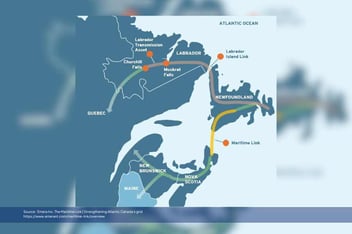
Gull Island: Construction of a new 2,700 MW hydroelectric facility on the Churchill River, approximately 100 kilometres southwest of Happy Valley-Goose Bay. Gull Island underwent a federal environmental assessment in 2012 as part of the Lower Churchill Hydro Electric Generation Project. Newfoundland and Labrador holds majority ownership.
Churchill Falls expansion: Upgrades to the 11 existing turbine units at the Churchill Falls Generating Station to increase capacity by 1,275 MW, representing a 30 per cent efficiency increase. The broader Churchill Falls expansion will increase capacity by up to 2,500 MW in total. A separate feasibility study for further expansion will also be conducted.
Labrador onshore wind: A new 2,000 MW onshore wind development in Labrador, to be developed via an independent power producer, with the federal government taking up to a 40 per cent equity stake providing an estimated CAD $1 billion in value (2026 NPV) to Newfoundland and Labrador.
Transmission: Construction of more than 660 kilometres of transmission lines and power infrastructure to deliver electricity from Churchill Falls and Gull Island to the Quebec border, with capacity for Newfoundland and Labrador to transmit power through Quebec to the United States.
The federal government committed CAD $10 billion in financing, including a federal loan guarantee for Gull Island. The total programme is described as nearly CAD $70 billion and will deliver 14,000 MW of clean renewable power. Under the agreement, Newfoundland and Labrador retains up to 2,350 MW of electricity from Churchill Falls and Gull Island. The agreement provides for 85 per cent of all person-hours of Gull Island construction employment to remain within Newfoundland and Labrador, with priority given to qualified Labrador Innu, qualified Labradorians and qualified Newfoundlanders, in that order.
The parties have set a target of 31 December 2026 to negotiate and execute long-form definitive agreements.
Sources: Prime Minister of Canada, 17 August 2026; Natural Resources Canada, backgrounder; Government of Newfoundland and Labrador, 17 August 2026; WaterPower Canada, DCIA explainer
Component 3: Wasoqonatl Intertie (Nova Scotia to New Brunswick Transmission)
The Wasoqonatl intertie is a new 160-kilometre, 345 kV transmission line running parallel to the existing connection between Onslow, Nova Scotia, and Salisbury, New Brunswick. “Wasoqonatl” means “keep light on” in Mi'kmaq.
In March 2025, the Canada Infrastructure Bank committed CAD $217 million in equity financing for the project. In January 2026, the CIB provided an additional CAD $54 million in equity loans to support Indigenous ownership, bringing its total commitment to CAD $285 million.
Project ownership is through a regulated utility corporation with Nova Scotia Power Inc., the Canada Infrastructure Bank, MUIN Transmission Limited Partnership and Wskijinu'k Mtmo'taqnuow Agency Limited (WMA) as limited partners. New Brunswick Power will build, own and operate the New Brunswick section of the project.
The Nova Scotia Energy Board approved the Wasoqonatl intertie project in 2025. Early vegetation work has begun, with full construction expected in 2026 and completion scheduled for 2028.
Sources: Canada Infrastructure Bank, Wasoqonatl project page; CIB, Indigenous equity announcement; Nova Scotia Power, Wasoqonatl project page
Component 4: New Brunswick Nuclear
New Brunswick Power, in partnership with ARC Clean Technology Canada, has proposed an ARC-100 small modular reactor at the Point Lepreau Nuclear Generating Station site. The Canadian Nuclear Safety Commission received an application for a licence to prepare the site in June 2023, and the application is under regulatory review. The project is also undergoing a provincial environmental impact assessment.
New Brunswick's 2023 energy strategy calls for 600 MW of new nuclear capacity at Point Lepreau by 2035. In March 2026, an independent NB Power Review Panel recommended that the province consider planning for an additional large-scale, proven technology nuclear plant alongside Point Lepreau, whilst raising concerns about SMR technology readiness. NB Power invested over CAD $800 million between 2022 and 2026 to upgrade the existing Point Lepreau facility, and in October 2025 signed a three-year Support Services Agreement with Ontario Power Generation's Laurentis Energy Partners to improve operational reliability.
Sources: CNSC, NB Power ARC-100 project page; NB Media Co-op, Review Panel report; CP24, NB Power-OPG partnership
Component 5: Mersey River Wind and Transmission Pre-feasibility
In February 2026, Natural Resources Canada announced CAD $25 million in funding to support Mersey River Wind, a 148.5 MW wind farm in Nova Scotia, and nearly CAD $5 million to Net Zero Atlantic for a pre-feasibility project to inform transmission options for the proposed Wind West project. The Mersey River Wind project is also supported by a CAD $206 million loan from the Canada Infrastructure Bank. The project will be the first renewable-to-retail licence in Nova Scotia.
Sources: Major Projects Office, Atlantic Energy Strategy, latest updates; CIB, Mersey River Wind
Development Stage (September 2026)
Status: Definitive Cooperation and Implementation Agreement signed for Churchill Falls/Gull Island; offshore wind prequalification complete; Wasoqonatl intertie under construction
The programme components are at different stages of advancement.
- Churchill Falls and Gull Island: DCIA signed 17 August 2026; long-form definitive agreements targeted for completion by 31 December 2026; referral to Major Projects Office planned upon conclusion of binding agreements
- Wind West offshore wind: four wind energy areas designated (July 2025); seven companies prequalified (June 2026); first Call for Bids expected in latter half of 2026; initial round covering 2.5 GW
- Wasoqonatl intertie: Nova Scotia Energy Board approved; early vegetation work commenced; full construction in 2026; completion targeted for 2028
- New Brunswick nuclear: ARC-100 SMR site preparation licence under CNSC review; provincial environmental impact assessment underway; NB Power Review Panel recommended assessment of large-scale reactor option
- Labrador onshore wind: 2,000 MW project announced as part of the DCIA; to be developed via independent power producer; early development stage
Sources: Prime Minister of Canada, 17 August 2026; Offshore Wind, prequalified bidders; Nova Scotia Power, Wasoqonatl; CNSC, NB Power ARC-100
Timeline
| Date |
Milestone |
| June 2023 |
NB Power submits ARC-100 SMR site preparation licence application to CNSC |
| 26 June 2025 |
Building Canada Act comes into force |
| 29 July 2025 | Four offshore wind energy areas designated (French Bank, Middle Bank, Sable Island Bank, Sydney Bight) |
| 29 August 2025 | Major Projects Office launched under Dawn Farrell |
| 11 September 2025 | Atlantic Energy Strategy referred to the MPO as a transformative strategy |
| 18 September 2025 | Joint strategic direction issued to CNSOER to initiate prequalification and Call for Information |
| 16 October 2025 | CNSOER launches prequalification and Call for Information (NS25-1R) |
| 28 October 2025 |
NB Power and Laurentis Energy Partners sign three-year Support Services Agreement for Point Lepreau |
| 13 January 2026 |
Prequalification and Call for Information closes |
| 21 January 2026 | CIB announces CAD $54 million in Indigenous equity loans for Wasoqonatl, bringing total to CAD $285 million |
| 4 February 2026 | Ottawa to Montreal (approximately 200 km) |
| February 2026 | NRCan announces CAD $25 million for Mersey River Wind and CAD $5 million for Wind West transmission pre-feasibility |
| February 2026 | Nova Scotia introduces Powering the Economy Act and Offshore Renewable Energy Revenue Act |
| March 2026 | NB Power Review Panel report published; recommends assessment of large-scale reactor |
| April 2026 | NB Power begins three-year partnership with OPG's Laurentis Energy Partners |
| 30 April 2026 | Churchill Falls Independent Review Committee submits report |
| June 2026 | CNSOER publishes list of seven prequalified bidders for offshore wind |
| 17 August 2026 |
Definitive Cooperation and Implementation Agreement signed for Churchill Falls and Gull Island; CAD $10 billion federal financing committed |
| Latter half of 2026 | First offshore wind Call for Bids expected |
| 31 December 2026 | Target for completion of long-form definitive agreements (Churchill Falls/Gull Island) |
| 2028 | Wasoqonatl intertie completion target |
Sources: Major Projects Office, Atlantic Energy Strategy; Prime Minister of Canada, 11 September 2025; Prime Minister of Canada, 17 August 2026; Government of Newfoundland and Labrador, 17 August 2026
Cost Summary
The Churchill Falls and Gull Island programme alone is valued at nearly CAD $70 billion, comprising generation, transmission and onshore wind components. Federal financing of CAD $10 billion has been committed.
Key Facts
| Category |
Information |
| Churchill Falls/Gull Island/Labrador transmission/Labrador wind |
Nearly CAD $70 billion total; CAD $10 billion in federal financing committed |
| Gull Island hydroelectric |
2,700 MW; federal loan guarantee confirmed; Newfoundland and Labrador majority ownership |
| Churchill Falls upgrades | 1,275 MW from turbine upgrades; up to 2,500 MW total expansion capacity |
| Labrador onshore wind | 2,000 MW; federal government up to 40 per cent equity stake; estimated CAD $1 billion value (2026 NPV) to NL |
| Wasoqonatl intertie |
CAD $285 million in CIB investment (equity and Indigenous equity loans) |
| Mersey River Wind | CAD $25 million NRCan funding; CAD $206 million CIB loan |
| Wind West transmission pre- feasibility | Nearly CAD $5 million (Net Zero Atlantic, via NRCan) |
Comprehensive cost estimates for the full Wind West offshore wind build-out, Atlantic Loop transmission and New Brunswick nuclear expansion have not been published by proponents. The Nova Scotia government projects the offshore wind sector to be a CAD $4.6 billion industry within seven years.
Sources: Prime Minister of Canada, 17 August 2026; Government of Newfoundland and Labrador, 17 August 2026; CIB, Wasoqonatl; Major Projects Office, Atlantic Energy Strategy
Regulatory Status
The Atlantic Energy Strategy was referred to the Major Projects Office on 11 September 2025 as a transformative strategy. The MPO was established under the Building Canada Act (in force 26 June 2025) and provides a single-window approach to streamline federal approvals, with a target of completing reviews within two years.
Churchill Falls and Gull Island: The DCIA provides for referral to the Major Projects Office upon the conclusion of binding agreements, which will coordinate and structure federal financing whilst accelerating permitting. Gull Island underwent a federal environmental assessment in 2012 as part of the Lower Churchill Hydro Electric Generation Project.
Wind West offshore wind: On 18 September 2025, the Government of Canada and Province of Nova Scotia issued joint strategic direction to the CNSOER to initiate the prequalification process and Call for Information. The prequalification process ran from 16 October 2025 to 13 January 2026. Seven companies and consortia prequalified, with the Call for Bids expected in the latter half of 2026. Designation of wind energy areas is not construction approval; successful bidders will still require project-specific environmental and regulatory approvals.
Wasoqonatl intertie: Approved by the Nova Scotia Energy Board in 2025.
NB nuclear (ARC-100 SMR): Site preparation licence application submitted to CNSC in June 2023; under regulatory review. Provincial environmental impact assessment underway.
Sources: Major Projects Office, Atlantic Energy Strategy; Natural Resources Canada, strategic direction; CNSC, NB Power ARC-100; Government of Newfoundland and Labrador, 17 August 2026
Indigenous Participation
Mi'kmaq and Mi'gmaq Nations (Nova Scotia, New Brunswick, Prince Edward Island)
The Wasoqonatl intertie is the most advanced Indigenous equity participation within the strategy. In January 2026, the Canada Infrastructure Bank provided CAD $54 million in equity loans: CAD $36 million to Wskijinu'k Mtmo'taqnuow Agency Limited (WMA), enabling Nova Scotia's 13 Mi'kmaw First Nations to acquire an equity stake; and CAD $18 million to MUIN Transmission Limited Partnership, supporting New Brunswick Mi'gmaq First Nations in securing their first ownership stake in a large-scale clean power project. Project ownership is through a regulated utility corporation with WMA and MUIN as limited partners alongside Nova Scotia Power and the CIB.
The Major Projects Office's description of the Atlantic Energy Strategy notes that the MPO will work with Indigenous Peoples to advance the strategy. The federal government committed CAD $40 million over two years to increase Indigenous capacity to engage on major projects.
Sources: CIB, Indigenous equity announcement; CIB, Wasoqonatl project page; Prime Minister of Canada, MPO launch
Innu Nation (Newfoundland and Labrador, Quebec)
The 17 August 2026 DCIA provides for priority hiring of qualified Labrador Innu in Gull Island construction employment, with 85 per cent of all person-hours guaranteed to remain within Newfoundland and Labrador. The agreement includes an opportunity for Labrador Innu participation in new transmission and wind assets in Labrador.
The Government of Newfoundland and Labrador stated it has begun conversations with representatives of the Innu Nation about opportunities for the Innu to engage as full partners in developments related to the agreement.
The Innu Nation and the provincial government have a prior relationship through the New Dawn (Tshash Petapen) Agreement, finalised in 2011 for the Muskrat Falls component of the Lower Churchill project, which included an Impact and Benefit Agreement and a Redress Agreement relating to the original Churchill Falls development.
Sources: Government of Newfoundland and Labrador, 17 August 2026; WaterPower Canada, DCIA explainer; Prime Minister of Canada, 17 August 2026
Nunatsiavut Government (Labrador Inuit)
The Nunatsiavut Government represents Labrador Inuit under a comprehensive land claims agreement covering northern and coastal Labrador. Nunatsiavut demonstrated through the Voisey's Bay nickel mine negotiations its capacity to secure substantial benefits and equity participation. Specific Nunatsiavut engagement terms for the Churchill Falls and Gull Island programme had not been publicly announced as of September 2026.
Federal Consultation Framework
The Major Projects Office is supported by an Indigenous Advisory Council. The MPO has committed CAD $40 million over two years to support Indigenous consultation and community readiness activities related to major projects. The Indigenous Loan Guarantee Program was doubled from CAD $5 billion to CAD $10 billion on 21 March 2025, extending eligibility beyond energy and natural resources to all major project sectors.
Sources: Prime Minister of Canada, Indigenous Advisory Council; Prime Minister of Canada, 17 August 2026
Technical Specifications
Wind West offshore wind
- Wind power potential: more than 60 GW in Nova Scotia
- Designated wind energy areas: French Bank, Middle Bank, Sable Island Bank, Sydney Bight (12,549 square kilometres total)
- French Bank: 20 km from shore (deeper waters, potentially floating turbines)
- Middle Bank, Sable Island Bank, Sydney Bight: 25 km from shore (depths suitable for fixed-bottom or floating turbines)
- Initial licensing target: 5 GW
- First Call for Bids round: 2.5 GW
- Capacity: up to 2,700 MW
- Location: Churchill River, approximately 100 km southwest of Happy Valley-Goose Bay
- Federal environmental assessment: completed in 2012
- Turbine upgrades: 1,275 MW (30 per cent efficiency increase across existing 11 turbines)
- Total expansion capacity: up to 2,500 MW
- Feasibility study for further expansion to be conducted
- Capacity: 2,000 MW
- Federal equity stake: up to 40 per cent
- More than 660 km of new transmission lines from Churchill Falls/Gull Island to Quebec border
- 160 km, 345 kV transmission line
- Route: Onslow, Nova Scotia, to Salisbury, New Brunswick (parallel to existing connection)
- Completion target: 2028
- Capacity: 148.5 MW
- First renewable-to-retail licence in Nova Scotia
Gull Island hydroelectric
- Capacity: up to 2,700 MW
- Location: Churchill River, approximately 100 km southwest of Happy Valley-Goose Bay
- Federal environmental assessment: completed in 2012
Churchill Falls expansion
- Turbine upgrades: 1,275 MW (30 per cent efficiency increase across existing 11 turbines)
- Total expansion capacity: up to 2,500 MW
- Feasibility study for further expansion to be conducted
Labrador onshore wind
- Capacity: 2,000 MW
- Federal equity stake: up to 40 per cent
Labrador transmission
-
More than 660 km of new transmission lines from Churchill Falls/Gull Island to Quebec border
Wasoqonatl intertie
- 160 km, 345 kV transmission line
- Route: Onslow, Nova Scotia, to Salisbury, New Brunswick (parallel to existing connection)
- Completion target: 2028
Mersey River Wind
- Capacity: 148.5 MW
- First renewable-to-retail licence in Nova Scotia
Sources: CNSOER, designated wind energy areas; Natural Resources Canada, 29 July 2025; Natural Resources Canada, backgrounder; Nova Scotia Power, Wasoqonatl
Sources
- Major Projects Office, Atlantic Energy Strategy
- Prime Minister of Canada, MPO launch, 29 August 2025
- Prime Minister of Canada, first projects referred to MPO, 11 September 2025
- Prime Minister of Canada, Churchill Falls and Gull Island, 17 August 2026
- Natural Resources Canada, backgrounder, 17 August 2026
- Government of Newfoundland and Labrador, DCIA announcement, 17 August 2026
- WaterPower Canada, Churchill Falls and Gull Island explainer
- Natural Resources Canada, four offshore wind areas designated, 29 July 2025
- Natural Resources Canada, strategic direction for offshore wind, 20 September 2025
- CNSOER, designated wind energy areas
- Canada Infrastructure Bank, Wasoqonatl project page
- Canada Infrastructure Bank, Indigenous equity loans for Wasoqonatl, January 2026
- Canada Infrastructure Bank, Mersey River Wind, February 2026
- Nova Scotia Power, Wasoqonatl Transmission Line
- Massachusetts, MOU announcement, 5 February 2026
- Canadian Nuclear Safety Commission, NB Power ARC-100 project page
- Prime Minister of Canada, Indigenous Advisory Council, 10 September 2025
- CNSOER, strategic direction notice, 18 September 2025
- Laurentis Energy Partners, NB Power SSA, 28 October 2025
- CDEV, changes to the Indigenous Loan Guarantee Program, 21 March 2025
- Nova Scotia Environmental Assessment, Mersey River Wind Farm