NEW WESTMINSTER RAIL BRIDGE REHABILITATION

Project Spotlight
New Westminster Rail Bridge
The New Westminster Rail Bridge is a single-track steel swing bridge crossing the Fraser River between New Westminster and Surrey in Metro Vancouver, British Columbia. Owned by the Government of Canada and operated by Canadian National Railway (CN) under an entrustment agreement since 1992, the bridge carries freight and passenger traffic for CN, Canadian Pacific Kansas City (CPKC), BNSF Railway, Southern Railway of British Columbia (SRY), VIA Rail, Amtrak and Rocky Mountaineer.
Sources: Wikipedia; Piling Canada, June 2023 (updated January 2026)
Built between August 1902 and July 1904, the bridge is a critical component of the Asia-Pacific Gateway transportation network. A 2011 study identified it as a capacity constraint, concluding that demand would surpass the bridge's capacity before 2030. In February 2021, the Canada Infrastructure Bank (CIB) initiated a network and capacity study in collaboration with Transport Canada, Public Services and Procurement Canada and Infrastructure Canada. As of September 2024, the study had narrowed to two options, with a preferred option identified.
Sources: Canadian Trucking Alliance, February 2021; Canada Infrastructure Bank; Wikipedia (citing Simpson, 2024 TAC Conference)
Project Overview
The bridge was designed by Waddell & Hedrick of Kansas City, Missouri, with the superstructure constructed by Dominion Bridge Company of Montréal, Québec. It originally carried both rail and road traffic on two decks. Following the opening of the Pattullo Bridge in November 1937, the upper road deck was removed. Ownership of the bridge was transferred from the Province of British Columbia to the federal government in October 1939. The bridge has served exclusively as a rail crossing since that time.
Sources: Wikipedia; Hardesty & Hanover; HistoricBridges.org
The bridge's total length is 543 metres excluding approaches. It has a design capacity of 60 trains per day, with current daily traffic at approximately 33 trains as of 2024. It opens for marine traffic approximately 20 times per day. The navigable clearance when the bridge is closed is 6.7 metres.
Sources: Wikipedia, citing Port of Vancouver, Port Information Guide, January 2024
The bridge is situated in a seismically active zone. Its main span is supported by eleven piers comprising unreinforced concrete faced with granite blocks. Analysis by Klohn Crippen Berger identified the foundations as vulnerable to soil liquefaction during a significant earthquake, with potential lateral spreading along the riverbed. CN commenced a phased seismic retrofit programme in 2020.
Sources: Klohn Crippen Berger; Piling Canada
Key Facts
| Category |
Information |
| Location |
New Westminster to Surrey, British Columbia (Fraser River) |
| Owner |
Government of Canada |
| Operator | Canadian National Railway (entrustment since 1992) |
| Other users | CPKC, BNSF, SRY, VIA Rail, Amtrak, Rocky Mountaineer |
| Bridge type | Single-track steel swing bridge |
| Designer | Waddell & Hedrick |
| Contractor | Dominion Bridge Company |
| Construction | August 1902 to July 1904 |
| Opened | 23 July 1904 |
| Length | 543 metres (excluding approaches) |
| Current daily traffic | Approximately 33 trains (2024) |
| Design capacity | 60 trains per day |
| Navigable clearance (closed) | 6.7 metres |
| Status | Seismic retrofit phase two approved; CIB study completed with preferred option identified |
Development
Two distinct work streams affect the bridge.
Seismic retrofit programme
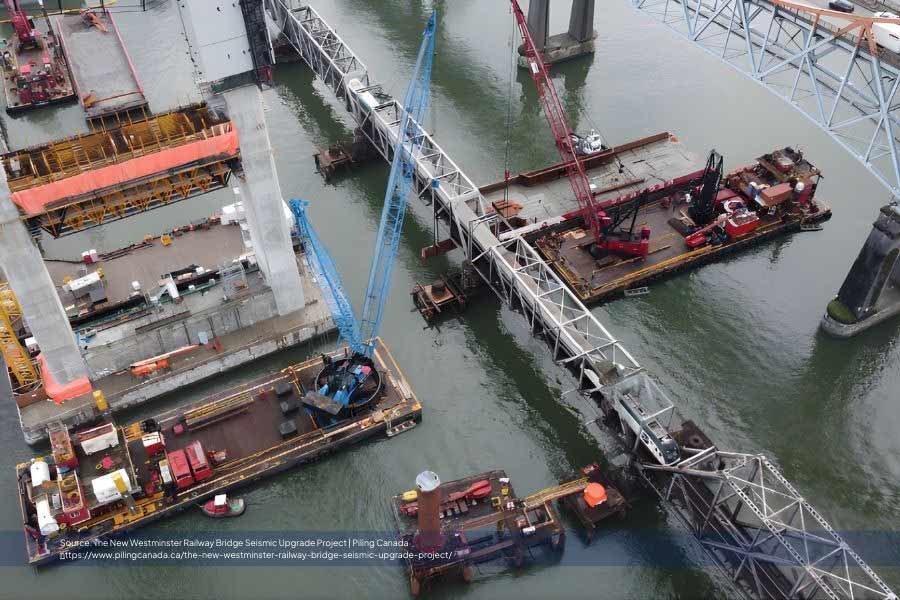
CN commenced seismic retrofit work in 2020, designed by Klohn Crippen Berger and delivered by Fraser River Pile and Dredge. The retrofit strategy drives large-diameter pipe piles upstream and downstream of the in-river piers, through liquefiable layers to glacial till, connected to the piers with steel collar frames. Replacing the bridge was assessed as impractical and not cost-effective for the seismic objective alone.
Phase one covered piers 6 through 10 and involved installation of ten 2,750 millimetre diameter steel piles with 51 millimetre thick walls, two at each pier, driven to depths of up to 77 metres. A new protection pier was also constructed at pier 6, comprising three 73 metre, 2,750 millimetre diameter steel piles. Phase one pile driving commenced in August 2021 and was completed by early 2026.
Sources: Piling Canada, June 2023 (updated January 2026); Klohn Crippen Berger
Phase two covers piers 2 through 5. The design for piers 3 and 4 uses an integrated sleeve frame system with approximately 16 piles of 1,524 millimetre diameter steel pipes strengthened with rebar and concrete (6 piles for pier 3, 10 for pier 4), together with composite marine timber walers. The design for pier 5 uses steel rings and struts connected to existing fender piling, with no below-waterline work anticipated. The Vancouver Fraser Port Authority and Transport Canada issued a Notice of Determination on 23 July 2026, concluding the project is not likely to cause significant adverse environmental effects. Construction is anticipated to commence in summer 2026 and be completed by end of 2027.
Sources: Impact Assessment Agency of Canada, project 90404
CIB network and capacity study
The Canada Infrastructure Bank initiated a network and capacity study in February 2021 under its Project Acceleration initiative. In collaboration with Transport Canada, Public Services and Procurement Canada and Infrastructure Canada, the study aimed to identify traffic needs of the New Westminster Rail Bridge, develop options for the crossing, identify infrastructure bottlenecks in the BC Lower Mainland and Prince Rupert networks, and develop capacity improvement recommendations. The study was originally anticipated for completion by the end of 2021.
Sources: Canada Infrastructure Bank; Canadian Trucking Alliance, February 2021; ReNew Canada, February 2021
At the Transportation Association of Canada conference in September 2024, study findings were presented identifying two options. The first is to replace the current single-track bridge with a new double-track bridge at the same location. The second, identified as the preferred option, is to retain the existing bridge with structural upgrades and build an additional double-track bridge upstream from the current crossing.
Sources: Wikipedia, citing Simpson, 2024 TAC Conference & Exhibition, Vancouver, September 2024
Timeline
| Date |
Milestone |
| August 1902 |
Toronto-Peterborough-Ottawa-Montreal-Laval-Trois-Rivieres-Quebec City |
| 23 July 1904 |
Approximately 1,000 kilometres |
| November 1937 |
Alto (Crown corporation, subsidiary of VIA Rail) |
| October 1939 |
Cadence consortium |
| December 1991 |
CAD 60 to 90 billion |
| 2004 | CAD 3.9 billion over six years |
| 2011 |
Dedicated, electrified high-speed passenger rail; peak speeds of 300 km/h or more |
| 2020 |
More than 17 million people (figures of 17 to 18 million appear across sources) |
| 1 February 2021 | Co-development phase (design, environmental assessment, consultation) |
| September 2024 |
Transformative strategy, referred 11 September 2025 |
| Early 2026 |
Ottawa to Montreal (approximately 200 km) |
| 24 April 2026 |
2029 or 2030 |
| 23 July 2026 |
More precise corridor alignment expected |
| Summer 2026 |
Federal impact assessment process expected to commence |
| End of 2027 |
Construction start target (first segment, Ottawa to Montreal) |
Sources: Wikipedia; Canada Infrastructure Bank; Impact Assessment Agency of Canada, project 90404; Piling Canada; Canadian Trucking Alliance
Bridge Specifications
The bridge's main span is supported by eleven piers of unreinforced concrete faced with granite blocks. Pier 1 is on land. Piers 2 through 5 rest on deep concrete caissons. Piers 6 through 11 rest on concrete-filled timber cribs with timber pile foundations installed by jetting into river sands. The superstructure consists of eight steel truss spans: five fixed spans of 48 metres on the south (Surrey) side, a centre-pier rim-bearing swing span of 116 metres, a fixed span of 116 metres, and a 69 metre span on the north (New Westminster) side. The northernmost span widens from 5.8 metres to 41 metres to accommodate the splitting and turning of the rail track. The bridge carries single standard-gauge track (1,435 mm) and is not electrified. The speed limit for trains is 11 miles per hour (18 km/h).
Original construction cost was CA$1,000,000 (1904 dollars).
Sources: Klohn Crippen Berger; Wikipedia; HistoricBridges.org; Hardesty & Hanover
Regulatory Status
The phase one seismic retrofit (piers 6 to 10) was registered as IAAC project 81023. The phase two works (piers 2 to 5) were registered as IAAC project 90404. A Notice of Intent was issued on 24 April 2026, with written public comments invited by 23 May 2026. A Notice of Determination was issued on 23 July 2026, concluding the project is not likely to cause significant adverse environmental effects. The assessment status is recorded as completed.
Sources: Impact Assessment Agency of Canada
Indigenous Context
The bridge crosses the Fraser River in the traditional territories of several Coast Salish nations, including the Musqueam (xʷməθkʷəy̓əm) and Kwantlen First Nations. The Qayqayt First Nation, officially the New Westminster Indian Band under the Indian Act, is historically associated with the immediate area. Qayqayt is one of the smallest First Nations in Canada and the only one registered without a land base, with 15 registered members as of June 2021.
Sources: Wikipedia, Qayqayt First Nation
The adjacent Pattullo Bridge replacement (renamed staləwasəm Bridge), which fully opened in February 2026, was built under a community benefits agreement that included Indigenous employment and apprenticeship provisions. The bridge received its name as a gift from the Musqueam Indian Band and Kwantlen First Nation. The bridge site overlaps the former Musqueam Reserve No. 1 and Kwantlen Reserve No. 8.
Sources: Wikipedia, Pattullo Bridge replacement
No structured Indigenous consultation or partnership framework specific to the New Westminster Rail Bridge has been publicly documented in any source reviewed. Any future major capital project involving the crossing would be expected to involve consultation with territorially relevant First Nations, consistent with current infrastructure practice in British Columbia.
Development Stage (September 2026)
Status: Seismic retrofit phase two approved; CIB capacity study completed
- Seismic retrofit phase one (piers 6 to 10) completed
- Seismic retrofit phase two (piers 2 to 5) received environmental determination on 23 July 2026; construction anticipated summer 2026 to end of 2027
- CIB capacity study identified two options: (1) replace current single-track bridge with a new double-track bridge, or (2) retain and upgrade existing bridge and build an additional double-track bridge upstream (preferred option)
- No capital commitment, construction timeline or formal project approval for a replacement or additional bridge has been announced
Sources: Canada Infrastructure Bank; Impact Assessment Agency of Canada, project 90404; Wikipedia
Sources
- Canada Infrastructure Bank, New Westminster Rail Bridge
- Impact Assessment Agency of Canada, project 90404 (piers 2 to 5)
- Impact Assessment Agency of Canada, project 81023 (piers 6 to 10)
- Klohn Crippen Berger, Seismic Retrofit of a 110-year Old Railway Bridge
- Piling Canada, The New Westminster Railway Bridge Seismic Upgrade Project, June 2023 (updated January 2026)
- Canadian Trucking Alliance, Study on New Westminster Rail Bridge, February 2021
- ReNew Canada, CIB collaboration for transportation capacity and feasibility study, February 2021
- Hardesty & Hanover, Fraser River Bridge, New Westminster
- HistoricBridges.org, New Westminster Railway Bridge
- Wikipedia, New Westminster Bridge
- Wikipedia, Qayqayt First Nation
- Wikipedia, Pattullo Bridge replacement