MACKENZIE VALLEY HIGHWAY

Project Spotlight
Mackenzie Valley Highway
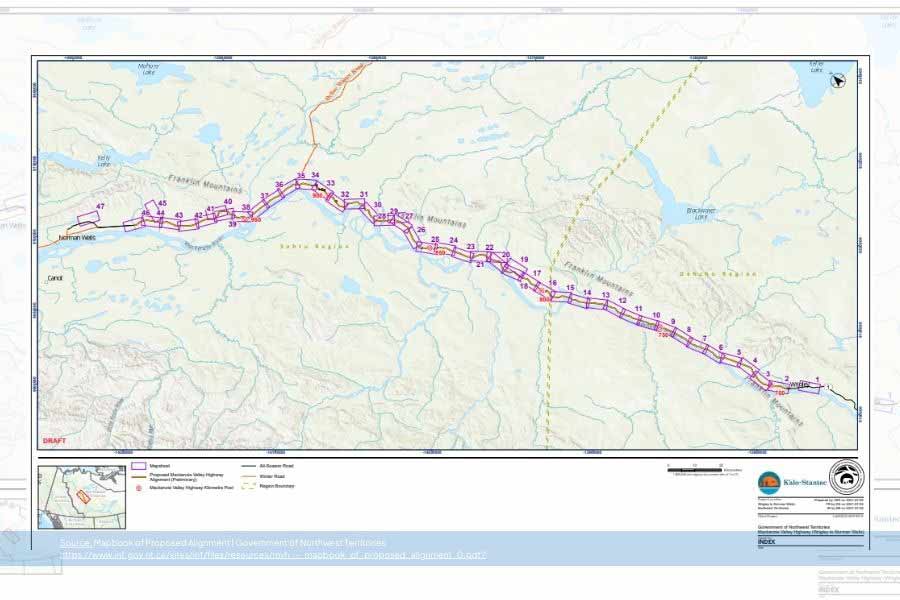
The Government of the Northwest Territories is advancing the Mackenzie Valley Highway, a proposed all-season gravel road of approximately 800 kilometres extending from Wrigley to the Dempster Highway south of Inuvik, passing near Tulita, Norman Wells and Fort Good Hope. The project was referred to Canada's Major Projects Office on 12 March 2026 and is being considered for listing as a project of national interest under the Building Canada Act.
Phase 1, covering approximately 320 kilometres from Wrigley to Norman Wells, is estimated at C$1.65 billion. The full corridor extension to Inuvik could add an estimated C$2 billion to the total cost. On 8 September 2026, the Government of Canada announced C$405 million in funding through the Arctic Infrastructure Fund to advance bridge construction, access roads and design work.
Sources: Major Projects Office; CBC News, 13 March 2026; CBC News, 8 September 2026
Overview
The Mackenzie Valley Highway would replace seasonal winter roads and air-only access for three currently isolated communities: Tulita, Norman Wells and Fort Good Hope. It would also improve access to two additional communities through extended and more reliable travel windows. The highway would create a direct route from Yellowknife to Inuvik, reducing the distance by approximately 1,200 kilometres and cutting travel time from roughly 38 hours to approximately 23 hours.
The vision for an all-season highway through the Mackenzie Valley dates to 1958, under Canada's Roads to Resources programme. Construction began in Fort Simpson in 1972, was halted south of Wrigley in 1977 following a moratorium on oil and gas development, and the final 18 kilometres to Wrigley were completed in 1994.
Sources: GNWT Department of Infrastructure; Major Projects Office
Key Facts
| Category |
Information |
| Location |
Wrigley to the Dempster Highway south of Inuvik, Northwest Territories (approximately 800 km) |
| Proponent |
Government of the Northwest Territories |
| Project Type | All-season gravel highway |
| Phase 1 Estimated Cost | C$1.65 billion (Wrigley to Norman Wells, approximately 320 km) |
| Full Corridor Estimated Cost | Approximately C$3.65 billion (including Inuvik extension) |
| Status | Referred to the Major Projects Office; environmental assessment ongoing; being considered for national interest listing under the Building Canada Act |
| Communities Served | Tulita, Norman Wells, Fort Good Hope (year-round access); Wrigley and Inuvik (improved access) |
| Sector | Transport |
Indigenous Partnerships
Development
Phase 1 of the highway proposes a two-lane gravel road between Wrigley and Prohibition Creek, located 28 kilometres southeast of Norman Wells. The project is expected to be built in three segments and is anticipated to take 10 years to construct over approximately 20 years, subject to construction funding and regulatory approvals. The three segments are: Wrigley to the Dehcho/Sahtu border (102 km); Tulita south to the Dehcho/Sahtu border (134 km); and Tulita north to the Prohibition Creek Access Road (45 km). Together these total approximately 281 km of new highway construction within the approximately 320 km Phase 1 corridor.
On 14 August 2026, the Government of the Northwest Territories requested that the Mackenzie Valley Environmental Impact Review Board expand the project scope from the Wrigley to Norman Wells corridor to include the full corridor extending from Wrigley to a connection with the Dempster Highway south of Inuvik. On 28 August 2026, the Review Board issued a Notice of Proceeding regarding the proposed change in scope.
Since 2018, 20.7 kilometres of road have been constructed through community capacity-building projects. A C$65 million realignment of existing federal funding was approved in mid-2026 to advance near-term bridge relocations, road resurfacing and access road construction along the corridor.
Sources: GNWT Department of Infrastructure; GNWT, C$65 million funding amendment; Government of Canada, C$405 million announcement
Development Stage (September 2026)
Status: Referred to the Major Projects Office; environmental assessment ongoing; under consideration for national interest listing
- Project referred to the Major Projects Office on 12 March 2026
- Government of Canada initiated the process towards potential listing as a project of national interest under the Building Canada Act on 24 June 2026
- Canada Gazette notice published on 29 August 2026; public comment period closes 1 October 2026
- Environmental assessment by the Mackenzie Valley Environmental Impact Review Board is ongoing; the Developer's Assessment Report was submitted in October 2023
- Scope expansion requested to cover the full Wrigley to Inuvik corridor (August 2026)
- C$405 million in new federal funding announced through the Arctic Infrastructure Fund on 8 September 2026
- Construction of ancillary road and bridge projects is under way or in procurement, including Highway 1 resurfacing, the Oscar Creek Bridge relocation and the Prohibition Creek Access Road
Sources: Major Projects Office; Government of Canada, 24 June 2026; Government of Canada, 28 August 2026; CBC News, 8 September 2026
Timeline
| Date |
Milestone |
| 1958 |
Toronto-Peterborough-Ottawa-Montreal-Laval-Trois-Rivieres-Quebec City |
| 1972 |
Approximately 1,000 kilometres |
| 1977 | Alto (Crown corporation, subsidiary of VIA Rail) |
| 1994 |
Cadence consortium |
| 2010 |
CAD 60 to 90 billion |
| 2013 | CAD 3.9 billion over six years |
| June 2018 |
Dedicated, electrified high-speed passenger rail; peak speeds of 300 km/h or more |
| October 2023 |
More than 17 million people (figures of 17 to 18 million appear across sources) |
| 12 March 2026 |
Co-development phase (design, environmental assessment, consultation) |
| 5 June 2026 |
Transformative strategy, referred 11 September 2025 |
| Mid-2026 |
Ottawa to Montreal (approximately 200 km) |
| 14 August 2026 |
2029 or 2030 |
| 28 August 2026 |
More precise corridor alignment expected |
| 29 August 2026 |
Federal impact assessment process expected to commence |
| 8 September 2026 |
Construction start target (first segment, Ottawa to Montreal) |
| 2026/2027 | First segment operational |
| 2027/2028 | Full network operational |
| 2028 | Final construction decision anticipated (subject to environmental assessment, permitting and funding) |
Sources: GNWT Department of Infrastructure; Major Projects Office; Cabin Radio, 5 June 2026; Government of Canada, 28 August 2026; CBC News, 8 September 2026
Cost Summary
Phase 1 of the project (Wrigley to Norman Wells, approximately 320 km) is estimated at C$1.65 billion. An extension of the corridor to Inuvik could add an additional estimated C$2 billion, bringing the total to approximately C$3.65 billion.
| Component |
Amount |
| Phase 1 corridor (Wrigley to Norman Wells, approximately 320 km; 281 km of new highway construction) |
C$1.65 billion (estimated) |
| Extension to Inuvik (Phase 2) |
Approximately C$2 billion (estimated) |
| Combined federal-territorial funding, June 2018 (environmental assessment, planning, Great Bear River Bridge, Mount Gaudet Access Road) | C$140 million (C$102.5 million federal, C$37.5 million territorial) |
| Federal funding realigned from 2018 NTCF agreement, mid-2026 (near-term construction and procurement) |
C$65 million |
| New federal funding, September 2026 (Arctic Infrastructure Fund) |
C$405 million |
| Road constructed to date (since 2018) | 20.7 km |
Funding for the full construction of the highway has not yet been secured. The GNWT continues to identify and evaluate funding opportunities.
Sources: GNWT Department of Infrastructure; CBC News, 5 March 2026; GNWT, C$65 million funding amendment; CBC News, 8 September 2026
Regulatory Status
The environmental assessment entered the Mackenzie Valley Environmental Impact Review Board in 2013. The Review Board issued its terms of reference to the GNWT in 2015. The Developer's Assessment Report was submitted to the Review Board in October 2023, following years of environmental, traditional knowledge and socioeconomic studies.
On 14 August 2026, the GNWT requested that the Review Board expand the environmental assessment scope from the Wrigley to Norman Wells segment to the full corridor extending to the Dempster Highway south of Inuvik. The Review Board issued a Notice of Proceeding regarding this proposed scope change on 28 August 2026.
Separately, the Government of Canada published a notice in the Canada Gazette on 29 August 2026 regarding the potential listing of the Mackenzie Valley Highway as a project of national interest under the Building Canada Act. National interest designation, if granted, would allow the federal government to streamline certain federal permitting. The NWT has stated that its own environmental assessment process would not be affected by the designation. The public comment period closes on 1 October 2026.
The GNWT expects the environmental assessment report and the responsible Minister's decision in 2026 or 2027, with regulatory permitting and authorisations to follow in 2027 or 2028. A final construction decision is anticipated in 2028, contingent on the environmental assessment, regulatory approvals and funding.
Sources: GNWT Environmental Assessment page; Government of Canada, 28 August 2026; Cabin Radio, August 2026; GNWT Department of Infrastructure
Indigenous Participation
The highway corridor passes through the territories of multiple Indigenous nations in the Dehcho and Sahtu regions, and, if extended to Inuvik, through the Gwich'in Settlement Area. The relevant land claim frameworks are:
The Gwich'in Comprehensive Land Claim Agreement (settled, 1992) covers the area around Inuvik and the Beaufort Delta, relevant if the corridor extends to the Dempster Highway.
The Sahtu Dene and Métis Comprehensive Land Claim Agreement (settled, 1993) covers the communities of Tulita, Norman Wells, Fort Good Hope, Déline and Colville Lake, through which the main Phase 1 corridor passes.
The Dehcho First Nations are engaged in ongoing land claim negotiations with Canada and the Government of the Northwest Territories. Their claim remains unsettled. The southern portion of the corridor, including the area around Wrigley, home of Pehdzéh Ki First Nation, a Dehcho member, passes through Dehcho territory.
On 5 June 2026, the Sahtu Secretariat Incorporated, the Gwich'in Tribal Council and the Pehdzéh Ki First Nation signed a Memorandum of Understanding establishing a coordinated Indigenous framework to work together on the governance, planning, co-design and long-term direction of the highway project. The MOU reflects the signatories' shared intention to participate directly in strategic and political decision-making, rather than solely through consultation processes.
The Mackenzie Valley Environmental Impact Review Board, which oversees the environmental assessment, includes membership from the Gwich'in Tribal Council, Sahtu Secretariat Incorporated, the Tlicho Government and the Dehcho First Nations. Indigenous land corporations have a direct role in the assessment process, given that the highway will be built through Indigenous-owned settlement lands.
Sources: Major Projects Office; Cabin Radio, 5 June 2026; Cabin Radio, August 2026; Mackenzie Valley Resource Management Act
Sources
- Government of the Northwest Territories, Department of Infrastructure, Mackenzie Valley Highway
- Government of the Northwest Territories, Environmental Assessment page
- Government of the Northwest Territories, C$65 million funding amendment, August 2026
- Government of the Northwest Territories, Developer's Assessment Report submitted, October 2023
- Canada's Major Projects Office, Mackenzie Valley Highway
- Government of Canada, Building Canada Act listing process initiated, 24 June 2026
- Government of Canada, Canada Gazette notice and next steps, 28 August 2026
- CBC News, Mackenzie Valley Highway construction to start this summer, 13 March 2026
- CBC News, Mackenzie Valley Highway plans and Inuvik extension, 5 March 2026
- CBC News, C$405 million investment, 8 September 2026
- Cabin Radio, Sahtu, Gwich'in, Pehdzéh Ki leaders sign MOU, 5 June 2026
- Cabin Radio, Regulatory approval process, August 2026
- Mackenzie Valley Environmental Impact Review Board, EA1213-02 registry
- Mackenzie Valley Resource Management Act
---CS.jpg?width=352&name=ENERGY---NORTH-COAST-TRANSMISSION-LINE-(BC)---CS.jpg)