Project Spotlight
Taltson Hydro Expansion
The Government of Northwest Territories (GNWT) is building a new 60 megawatt hydroelectric generation facility near the existing 18 megawatt (recently overhauled to 22 megawatt) Taltson facility south of Great Slave Lake and constructing a 320 kilometre transmission line, including an underwater section beneath the lake, to connect the territory's North and South Slave electrical grids for the first time. The project will serve 11 communities across the Northwest Territories and provide clean power to the mineral-rich Slave Geological Province, at an estimated total cost of CAD $2 to $3 billion.
The project was referred to the federal Major Projects Office on 12 March 2026. The Government of Canada has committed CAD $48 million to the project since 2019, including up to CAD $25 million conditionally approved through the Critical Minerals Infrastructure Fund in November 2024. The expansion is being developed collaboratively with NWT Métis Nation, Akaitcho Dene First Nations, and Salt River First Nation under a Memorandum of Understanding signed in 2021, and Indigenous partner groups signed a Letter of Intent in April 2026 to form a joint entity that will serve as their commercial ownership vehicle for the project. In August 2026, Deninu Kųę́ First Nation (a member of the Akaitcho Dene First Nations) formally suspended its support for the project pending recognition of its legacy impacts from the original Taltson facility and commitments regarding procurement opportunities and participation in related northern projects.
Sources: Major Projects Office; GNWT Infrastructure; Natural Resources Canada, 13 November 2024; Cabin Radio, 10 September 2026
Overview
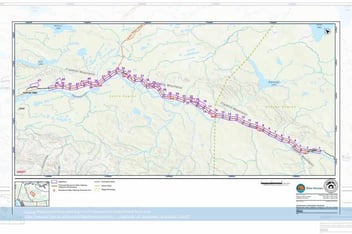
The Taltson Hydro Expansion will add 60 megawatts of generation capacity through a new hydroelectric facility near the existing Taltson site, and will connect the Taltson system to the Snare hydro system through a new transmission line, creating a more integrated northern electricity grid. The connection involves approximately 160 kilometres of overland transmission to the south end of Great Slave Lake, east of Fort Resolution, then a submarine cable across the lake into the Yellowknife area.
Once complete, the combined Taltson and Snare systems would offer approximately 120 megawatts of capacity and serve roughly 70 per cent of the Northwest Territories' population. The project would also set the stage for a future connection of the Northwest Territories grid to provincial electricity networks in Alberta or Saskatchewan.
Sources: Major Projects Office; GNWT Infrastructure; Cabin Radio, 7 February 2026
Key Facts
| Category |
Information |
| Location |
Taltson River, approximately 64 kilometres north of Fort Smith, south of Great Slave Lake, Northwest Territories |
| Proponent |
Government of Northwest Territories |
| Indigenous Partners |
NWT Métis Nation, Akaitcho Dene First Nations, Salt River First Nation (2021 MOU); Letter of Intent signed April 2026; Deninu Kųę́ First Nation support suspended August 2026 |
| Generation Expansion |
60 megawatt new facility alongside existing 22 megawatt facility (originally 18 megawatts; upgraded during 2023 to 2025 overhaul) |
| Transmission |
320 kilometre transmission line (including submarine cable beneath Great Slave Lake) at 230 kilovolts |
| Estimated Value |
CAD $2 to $3 billion |
| Federal Funding Committed |
CAD $48 million since 2019 |
| Status | Referred to Major Projects Office, March 2026 |
| Construction Decision | argeted by 2029 |
| Target Completion |
As early as 2034; MPO target: producing power within 10 years of referral |
Sources: Major Projects Office; GNWT Infrastructure; Natural Resources Canada, 13 November 2024; Cabin Radio, 10 June 2025; Cabin Radio, 10 September 2026
Development
The existing Taltson hydroelectric facility was constructed in 1965 to supply electricity to the Pine Point Mine. The facility began providing power to Fort Smith and Fort Resolution in the 1960s. Since 1986, it has also provided primary power to additional communities in the South Slave region, including Hay River, Enterprise, and K'atl'odeeche First Nation. The facility underwent a major overhaul from May 2023 to April 2025, returning to service with a current generation capacity of 22 megawatts (up from an original capacity of 18 megawatts). The Northwest Territories Power Corporation (NTPC, a wholly owned subsidiary of NT Hydro, which is 100 per cent owned by the GNWT) operates the existing facility.
The expansion project proposes to build a new 60 megawatt generation facility near the existing site and connect the Taltson grid to the Snare hydro system through a 320 kilometre transmission line, including a submarine cable across Great Slave Lake. In its current form, the preferred route involves approximately 160 kilometres of overland transmission to the south end of Great Slave Lake, east of Fort Resolution, then a submarine cable across the lake into the Yellowknife area. Routing on the northern shore is still being determined.
Sources: NTPC, 1 April 2025; Major Projects Office; Cabin Radio, 7 February 2026; Yellowknifer, 9 June 2026
Development Stage (September 2026)
Status: Referred to Major Projects Office; pre-construction phase
- Referred to the Major Projects Office on 12 March 2026
- Federal funding of CAD $48 million committed since 2019, including up to CAD $25 million conditionally approved through the Critical Minerals Infrastructure Fund (November 2024)
- Partnership established with Indigenous government groups via 2021 Memorandum of Understanding
- Indigenous partner groups signed Letter of Intent in April 2026 to form joint commercial ownership entity
- Deninu Kųę́ First Nation suspended its support for the project in August 2026; the GNWT has stated it is committed to resolving outstanding concerns and the partnership remains under discussion
- Legacy issue resolution process underway with Indigenous partners and Crown-Indigenous Relations and Northern Affairs Canada
- Work underway to define commercial arrangements, ownership structure, and project footprint including transmission and hydro infrastructure planning
- Environmental assessment application targeted for submission by March 2027
Sources: Major Projects Office; GNWT Infrastructure; CBC, 18 April 2026; Cabin Radio, 10 September 2026; CBC, 11 September 2026
Timeline
| Date |
Milestone |
| 1965 |
Original Taltson facility constructed at 18 megawatts to power Pine Point Mine |
| 1960s |
Taltson begins providing power to Fort Smith and Fort Resolution |
| 1986 | Taltson begins providing primary power to South Slave communities beyond Fort Smith and Fort Resolution, including Hay River, Enterprise, and K'atl'odeeche First Nation |
| January 2019 | Federal and territorial governments announce initial joint investment in Taltson expansion |
| 2021 | Memorandum of Understanding signed with Indigenous government partners |
| 2022 | Northwest Territories joins federal Regional Energy and Resource Tables |
| May 2023 | Existing Taltson facility shut down for major overhaul |
| 13 November 2024 |
Up to CAD $25 million conditionally approved through Critical Minerals Infrastructure Fund |
| April 2025 | Taltson facility returns to service at 22 MW following overhaul (up from original 18 MW) |
| 28 May 2025 | Minister Wawzonek presents integrated energy and climate approach to Legislative Assembly, with Taltson as centrepiece |
| 12 March 2026 | Project referred to the Major Projects Office by Prime Minister Carney |
| April 2026 | Indigenous partner groups sign Letter of Intent to form joint commercial ownership entity |
| August 2026 | Deninu Kųę́ First Nation suspends support for the Taltson expansion |
| March 2027 (target) |
Environmental assessment application submission |
| 2029 (target) | Construction decision |
| 2034 (earliest target) | Expansion completed and producing power |
Cost Summary
The total project is estimated at CAD $2 to $3 billion. NWT Infrastructure Minister Caroline Wawzonek described this as a "rough estimate" in June 2025, acknowledging costs have escalated from the previous CAD $1 billion estimate.
The Government of Canada has committed CAD $48 million to the project since 2019. This includes up to CAD $25 million conditionally approved through the Critical Minerals Infrastructure Fund in November 2024, with final approval pending completion of due diligence by Natural Resources Canada. The earlier federal investments supported pre-construction milestones, Indigenous consultation, and legacy issue resolution.
The GNWT is working with the Canada Infrastructure Bank (CIB) on developing a business case and financial structure for the project. Commercial agreements and ownership structures are being developed between the Government of Canada, the CIB, Indigenous government partners, and the GNWT.
Sources: Cabin Radio, 10 June 2025; GNWT Infrastructure; Natural Resources Canada, 13 November 2024; Canada Infrastructure Bank
Regulatory Status
The project was referred to the federal Major Projects Office on 12 March 2026, announced by Prime Minister Carney as part of a comprehensive plan for northern infrastructure and defence. The MPO is working with Crown-Indigenous Relations and Northern Affairs Canada and affected Indigenous communities to understand the legacy impacts of the original Taltson Dam. The MPO is also collaborating with the GNWT to assess the project's financial and business case and support and streamline relevant regulatory processes, recognising the unique treaty-based impact assessment framework in the Northwest Territories.
No formal environmental assessment application has been submitted. The GNWT targets submission of an environmental and regulatory application by March 2027. If approvals and financing progress as planned, a construction decision could be made by 2029.
Sources: Major Projects Office; PM of Canada, 12 March 2026
Indigenous Participation
The Taltson expansion is being developed collaboratively with NWT Métis Nation (representing the Fort Resolution Métis Council, Hay River Métis Government Council, and the Fort Smith Métis Council), Akaitcho Dene First Nations (representing Łutsel K'e Dene First Nation, Deninu Kue First Nation, and Yellowknives Dene First Nation), and Salt River First Nation. These Indigenous governments entered a Memorandum of Understanding with the GNWT in 2021, establishing a steering committee to advance the project together.
In April 2026, the Indigenous partner groups signed a Letter of Intent to form a joint entity that will serve as their commercial ownership vehicle for the Taltson project. In a May 2025 address to the Legislative Assembly, Minister Wawzonek described the expansion as having "the potential to connect 70 per cent of our population to clean, renewable hydro power while connecting two major energy grids."
In August 2026, Deninu Kųę́ First Nation, a member of the Akaitcho Dene First Nations and the Indigenous community most directly affected by the original Taltson facility, formally suspended its support for the expansion. The First Nation stated it would not return support until the GNWT and participating Indigenous governments recognise Deninu Kųę́ First Nation's legacy impacts from the original Taltson dam and commit to sharing procurement opportunities and the benefits of broader northern development. Minister Wawzonek stated the GNWT is committed to resolving these concerns and expressed confidence the partnership can be restored. The GNWT Infrastructure page now lists Deninu Kųę́ First Nation's participation as "under discussion."
The partnership addresses concurrent workstreams: development of commercial agreements and ownership structures, resolution of legacy impacts from the original 1965 Taltson facility, engagement on land use and Indigenous Knowledge, and preparation of a joint environmental and regulatory application.
The GNWT is working with the Major Projects Office and Crown-Indigenous Relations and Northern Affairs Canada on understanding the legacy impacts of the original Taltson Dam and on options for Indigenous economic participation in the expansion project.
Sources: Major Projects Office; GNWT Infrastructure; GNWT, 28 May 2025; CBC, 18 April 2026; Cabin Radio, 10 September 2026; CBC, 11 September 2026; CKLB Radio, 27 August 2026
Technical Specifications
- Type: Hydroelectric generation expansion and transmission system integration
- Existing facility: Originally 18 megawatts (constructed 1965); upgraded to 22 megawatts during overhaul (2023 to 2025)
- New generation facility: 60 megawatts
- Transmission: 320 kilometre line at 230 kilovolts, comprising approximately 160 kilometres overland and approximately 160 kilometres submarine cable beneath Great Slave Lake
- Service area: 11 communities; approximately 70 per cent of the Northwest Territories population
- Combined system capacity (Taltson and Snare): approximately 120 megawatts
- Generation profile: Hydroelectric (renewable)
- Greenhouse gas reduction: Up to 240,000 tonnes annually, representing approximately 18 per cent of the territory's annual emissions
- Taltson River generation potential: 200 megawatts total
Sources: Major Projects Office; GNWT Infrastructure; NTPC, 1 April 2025; Yellowknifer, 9 June 2026; GNWT/Newswire, 23 January 2019
Strategic Context
The Taltson expansion forms part of a broader set of northern infrastructure projects being advanced through the Major Projects Office. Prime Minister Carney's 12 March 2026 announcement positioned the expansion alongside the Mackenzie Valley Highway, Grays Bay Road and Port, and the Arctic Economic and Security Corridor as integrated northern development.
The Northwest Territories historically relied on diamond mining, with major mines approaching end-of-life. The Slave Geological Province contains mineral deposits including copper, zinc, and gold, and opportunities will also be explored to leverage power from the facility to support the expanded NORAD Forward Operating Location in Yellowknife.
The project aligns with the federal Canadian Critical Minerals Strategy (2022) and with the Northwest Territories' commitment to achieving net-zero greenhouse gas emissions by 2050, announced in 2024. The Northwest Territories joined the federal Regional Energy and Resource Tables process in 2022 to collaborate with the federal government and Indigenous partners on low-carbon economy opportunities.
Sources: PM of Canada, 12 March 2026; Major Projects Office; GNWT, 28 May 2025; Natural Resources Canada, 13 November 2024; Canada 2025 Emissions Reduction Progress Report; Natural Resources Canada, 13 October 2022
Resources
- Major Projects Office, Taltson Hydro Expansion (updated 21 May 2026)
- GNWT Infrastructure, Taltson Hydro Expansion
- Natural Resources Canada, news release, 13 November 2024
- Prime Minister of Canada, news release, 12 March 2026
- GNWT, Minister Wawzonek address on energy and climate change, 28 May 2025
- GNWT/Newswire, joint investment announcement, 23 January 2019
- NTPC, Taltson Hydro Unit returns to service, 1 April 2025
- Canada Infrastructure Bank, Taltson project page
- Cabin Radio, Taltson expansion cost estimate, 10 June 2025
- Cabin Radio, South Slave Taltson expansion, 7 February 2026
- CBC News, Indigenous groups letter of intent, 18 April 2026
- Yellowknifer, Northern Construction: Taltson, 9 June 2026
- Cabin Radio, Deninu Kųę́ First Nation pulls support, 10 September 2026
- CBC News, Akaitcho First Nations support wavers, 11 September 2026
- CKLB Radio, Deninu Kųę́ First Nation pulls plug on Taltson, 27 August 2026
- Canada 2025 Emissions Reduction Progress Report
- Natural Resources Canada, Regional Energy and Resource Tables Phase 2, 13 October 2022