THE VIEW | Canada's Best Investment Story Is the One It Isn't Telling.

Everyone sees the pipeline. Few see what's making it move.
Canada has always been an investment destination. What is changing is how clearly the market can now see why.
The confidence is reflected in the numbers. But the deals reveal something more specific.
When 94 per cent of global institutional investors plan to maintain or increase their Canadian exposure, confidence in the country is clearly strong. But the projects attracting capital reveal something more specific about what is driving that confidence.
Why Capital Is Coming to Canada
The case for Canada's investment appeal is well established. The Global Infrastructure Investor Association's Spring 2026 Pulse Survey ranked Canada first for infrastructure investment attractiveness, ahead of both the United States and Germany, for the first time since the survey began in 2020.¹ CPP Investments' own Insights Institute found that the 94 per cent retention figure was the highest of any of the eight developed markets surveyed, ahead of Japan at 82 per cent and the United States at 77 per cent.²
The transactions reinforce that confidence. On 3 November, Blackstone and four of Canada's largest pension funds paid US$3.1 billion for a 49.9 per cent stake in the Mitsubishi subsidiary holding its interest in LNG Canada, just three weeks after Phase 2 approval.³ In September, Ottawa presented a 66-page deal book to global investors at the Canada Investment Summit, listing roughly 80 projects across eight sectors seeking tens of billions in financing.
Canada's appeal is often attributed to its political stability, natural resources, predictable regulatory environment and rule of law. These advantages have undoubtedly helped build investor confidence, but they do not tell the whole story.
The Projects Changing the Equation
The projects attracting capital offer a closer look at what is shaping Canada's investment appeal. Across the country's energy and infrastructure sectors, a common feature is beginning to emerge.
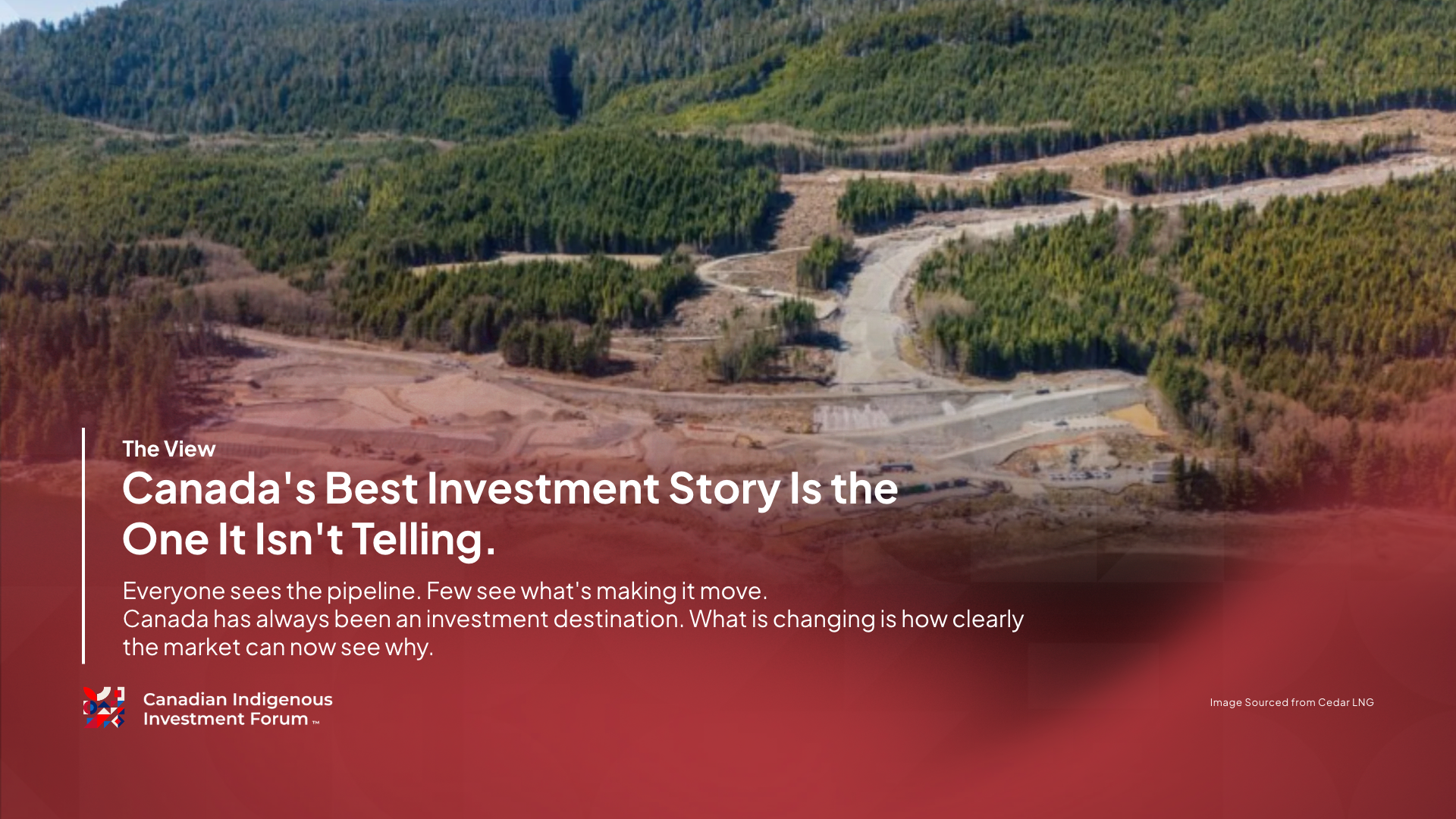
Cedar LNG is majority-owned by the Haisla Nation.
BC Hydro's 2025 Call for Power awarded contracts to four wind projects, each with 51 per cent Indigenous equity, alongside roughly £2.3 billion (C$4.3 billion) in private investment.⁴
Ontario's IESO LT2 Energy Window contracted 14 projects, all at least 50 per cent Indigenous-owned, at prices 21 per cent below the province's previous renewable procurement round.⁵
Wataynikaneyap Power is 51 per cent Indigenous-owned, now operational and filing its first rate case with the Ontario Energy Board.
Then there's the Westcoast/Stonlasec8 bond, which brought together FNFA's sustainable bond structure and a federal guarantee.
These are not isolated developments. They are substantial investments across Canada's energy and infrastructure sectors, and they point to a shift in how major projects are structured and financed.
Ontario offers a particularly telling example: projects with at least 50 per cent Indigenous ownership secured contracts at prices 21 per cent below the previous procurement round.
BC Hydro's procurement process reinforces the same point. Taken together, these transactions suggest that something more than investor confidence in Canada is at work.
What Sits Behind the Pattern
There is a commercial logic behind it. Long-duration capital prices consent risk alongside commodity risk, construction risk and regulatory risk. An equity partner has a direct financial interest in a project's long-term success and a stake in the decisions that shape the asset over its lifetime. That alignment can influence how a project is financed, developed and delivered.
But these partnerships do not emerge in isolation. They depend on financial institutions and mechanisms capable of supporting Indigenous participation at scale. That architecture has been building for years, and it is now beginning to show its reach.
The significance lies not in creating an entirely new pool of capital, but in changing how it is deployed, how ownership is structured and how Indigenous Nations participate in the economics of major projects. With Indigenous interests formally embedded in the financing structure, other parties gain greater certainty over consent, ownership and the project's long-term development.
The First Nations Finance Authority has surpassed £2.27 billion (C$4.2 billion) in cumulative lending to more than 100 member Nations. No First Nation has ever defaulted on an FNFA loan. The organisation has been lending for nearly two decades. What is changing now is its scale and capacity.⁷
The Canada Infrastructure and Indigenous Loan Guarantee Corporation has also backed three separate transactions, including an approximately £386 million (C$715 million) co-guarantee for the Darlington New Nuclear Project in June, the first joint federal-provincial guarantee of its kind.⁸
Federal policy is also beginning to build on that foundation.
On 26 October, Prime Minister Carney brought First Nations leaders and provincial premiers together for the first time in two decades, marking a significant moment in Canada's approach to Indigenous economic participation.⁶ The meeting was followed by two important developments. Ottawa announced plans to amend the First Nations Fiscal Management Act, expanding the lending authority of the First Nations Finance Authority.
Carney also tasked the Minister of Finance with working alongside First Nations leaders on a proposed First Nations Sovereign Wealth Fund, which would give Nations a direct financial stake in revenues from major projects on or near their territories. As more projects move towards financing, the FNFA expects its lending activity to expand further.⁹
A New Architecture for Canadian Investment
Canada's investment story has largely centred on what the country offers: political stability, natural resources, regulatory predictability and a growing pipeline of major projects. The confidence figures reinforce that picture. But look more closely at the projects attracting capital, and another part of the story emerges. Indigenous financial institutions and equity partnerships are helping turn Canada's investment potential into bankable opportunities, while bringing greater certainty around consent, ownership and the long-term governance of major projects.
That shift is already underway. Indigenous Nations are moving beyond participation in individual projects to building the financial capacity to take larger ownership stakes, mobilise capital and shape how major developments are financed. The First Nations Finance Authority's expanding lending capacity, federal loan guarantees and the proposed First Nations Sovereign Wealth Fund are helping make that possible.
The significance extends beyond the projects already underway. Ottawa's new Canada Strong Fund, seeded with £13.5 billion (C$25 billion), was framed partly around the capital Canada needs to attract. The International Institute for Sustainable Development published its recommendations for the fund this month, noting that Canada's net-zero transition alone requires between £67.5 billion and £75.6 billion (C$125 billion and C$140 billion) a year.¹⁰ Meeting that demand will require more than a list of proposed projects. It will take financial structures capable of bringing together institutional capital, public financing and long-term economic partnerships.
What is emerging is more than a series of successful transactions. It is a different approach to developing Canada's major assets, one that brings Indigenous ownership, institutional capital and long-term project financing into closer alignment. As Indigenous interests become embedded in ownership and governance structures from the outset, investors gain greater clarity around consent, decision-making and the interests underpinning a project's long-term success.
The Next Era of Canadian Investment
The shift is already visible in the projects taking shape across the country. Indigenous equity partnerships are helping establish the conditions for long-term investment, while Indigenous financial institutions are expanding the capacity to support it. Together, they point towards an investment model in which Indigenous Nations play a more substantial role in the ownership, financing and development of Canada's major assets.
For institutional investors, the opportunity extends beyond the volume of capital Canada can attract to the certainty embedded in how projects are structured, from consent and governance to the alignment of long-term interests.
Canada has spent years making the case for its resources, stability and investment potential. It may now be entering a different phase: one in which the strength of its investment proposition is shaped not only by what the country has, but by how it builds, finances and shares in the value of what comes next.
The next generation of Canadian investment may look very different from the last. And the foundations are already being laid.
The View is an editorial by Mark Magnacca, Co-Chair and CEO of the Canadian Indigenous Investment Forum.
Sources
1 Infrastructure Pulse Survey: Spring 2026, North America and Europe, Alvarez & Marsal / Global Infrastructure Investor Association. → Link
2 Canada Leads Global Investor Confidence, But Scale Gap Remains: CPP Report, Wealth Professional, 8 September 2026. → Link
3 Blackstone and Leading Canadian Institutional Investors Announce $3.1B Investment in Mitsubishi Corporation's Interest in LNG Canada, Blackstone, 2 November 2026. → Link
4 BC Hydro 2025 Call for Power Results, reported via Wealth Professional and sector coverage, May 2026.
5 IESO LT2 Energy Window 1 Results, Independent Electricity System Operator, 9 April 2026.
7 Prime Minister Carney Convenes First Nations Leadership and First Ministers for the First Time in Two Decades, Launches Discussions on a New First Nations Sovereign Wealth Fund, Prime Minister of Canada, 26 October 2026. → Link
8 Two Decades of FMA Leadership Driving Economic Reconciliation in Canada, First Nations Financial Management Board / First Nations Finance Authority, 1 April 2026. FNFA cumulative lending surpassed C$4.2 billion. → Link
9 Government Announces Largest Indigenous Loan Guarantee in Canadian History to Support Darlington New Nuclear Project, Department of Finance Canada, 23 June 2026. Approximately C$715 million in financing supported by CILGC and the Province of Ontario on a 50/50 basis. → Link
10 Canada Indigenous Group Expects Lending Boom With New Projects on Horizon, Bloomberg, 4 November 2026.
11 Canada Strong Fund Could Help Unlock Ottawa's Goal of CAD 140 Billion Annually for Net-Zero, International Institute for Sustainable Development, 2 November 2026. → Link