A record C$800 million debenture marks the institution’s largest ever bond. Canada holds one of the world’s largest energy reserves and an AAA sovereign rating. With geopolitical disruption repricing global oil, gas, and energy supply, the question for institutional investors is not whether to invest, but when.
KEY TAKEAWAYS
- FNFA’s C$800 million debenture on June 2026 is the institution’s largest ever, pushing its total loan portfolio past C$5 billion across 195 First Nation borrowing members.
- The bond attracted 52 institutional investors, the highest international buyer contingent in FNFA’s history, with spread tightening to 5.5 basis points off Ontario provincial benchmarks.
- Proposed amendments to the First Nations Fiscal Management Act would enable FNFA to lend to Indigenous-owned Special Purpose Vehicles, shifting recourse from nation balance sheets to project-level structures. Draft legislation has been received; passage is expected in autumn 2026.
- The Canada Investment Summit (September 2026) and FNFA's evolving issuance programme present a near-term entry point for institutional investors assessing Canadian Indigenous credit exposure.
Most institutional investors have never evaluated a First Nations-led credit instrument, but the ones who have are coming back for more.
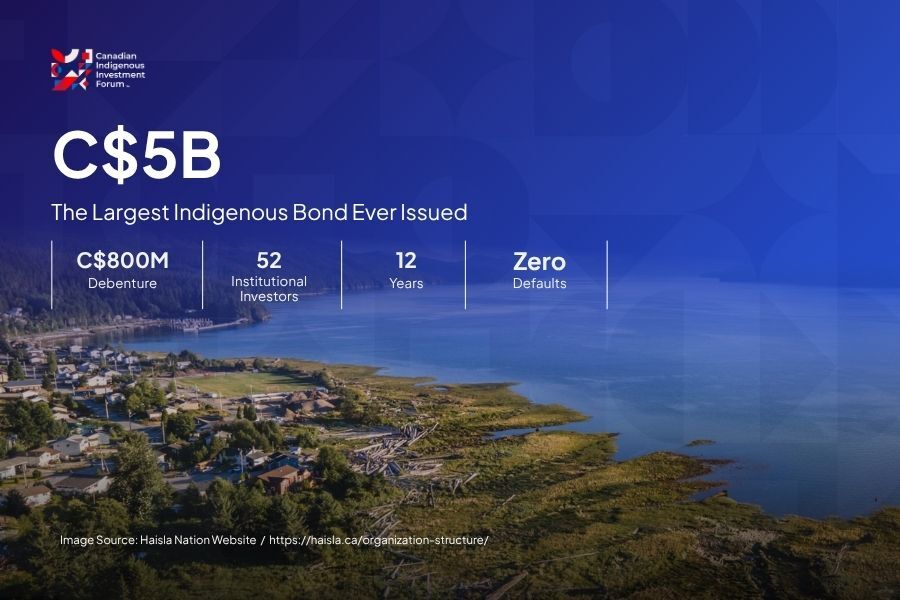
The First Nations Finance Authority first issued bond credits in 2014. In June 2026, just twelve years later, the FNFA issued a C$800 million debenture, its largest ever, pushing its total loan portfolio past C$5 billion across 195 First Nation borrowing members.
With no recorded borrower default, the FNFA carries an AA- rating from S&P and Aa3 from Moody’s, indicating stable loan environments. And it just priced at 5.5 basis points off the Province of Ontario, the tightest spread in its history.
Comparable models already exist in Europe through the Nordic municipal credit institutions: Kommuninvest in Sweden, KBN in Norway, and MuniFin in Finland. Like these entities, pooled borrowing structures can achieve investment-grade ratings through diversified revenue streams and rigorous credit discipline rather than explicit sovereign backing.
FNFA operates on broadly the same principles, albeit within a framework that has yet to be widely understood in international capital markets:
Indigenous infrastructure in an AAA-rated G7 economy, sitting on one of the world's largest energy resource bases, at a time when the world’s steady access to energy supply is left uncertain.
The Record C$800 Million Bond
The bond did not just clear the market. It was oversubscribed by C$61 million.
Fifty-two institutional investors participated, the highest number on any FNFA issuance. International buyers made up the largest contingent in the institution’s bond history. And the pricing moved in FNFA’s favour through the day of execution.
“It started out in the morning and we were looking around six, six and a half basis points and just shortly before we pulled the trigger, it tightened a bit more to 5.5. That’s the tightest to Ontario that we’ve been since we’ve issued.”
— Ernie Daniels, CPA, CAFM, President and CEO, First Nations Finance Authority; Member, Bank of Canada Board of Directors; Salt River First Nation, Northwest Territories
The pace has not slowed. FNFA has issued C$1 billion in the first three months of its 2026 fiscal year and expects to issue a further billion before September. In April, Environmental Finance awarded FNFA the Sustainability Bond of the Year (Agency) for its C$350 million, 30-year sustainable bond financing the Haisla Nation’s Cedar LNG project. Daniels sees a direct line between the award and the investor appetite that followed.
The bonds were oversubscribed by C$61 million, the institution has multiple structures in place across different tenors, and international demand is running at levels FNFA has not seen before.
.jpg?width=900&height=600&name=20260624%20-%20From%20First%20Bond%20to%20Record%20Debenture%20-%20CIIF%20(1).jpg)
Investors Are Setting the Terms
The size of the bond is one story. The nature of the demand is a better one.
In earlier years, FNFA issued a product and the market either bought it or it did not. That dynamic has shifted. International investors are now telling FNFA what they want: specific maturities, specific structures, specific terms.
Daniels describes the feedback loop in concrete terms. The year before, investors asked whether FNFA issued a five-year bond. It did not, at the time, and after implementing the five-year bond, demand has increased.
Right now, the institution is looking at seven-year tenors and private placements.
Seven-year tenors and private placement structures open pathways for funds operating with specific duration mandates or those that prefer bilateral execution over public syndication. The product is evolving toward them, not away from them.
The shift is not only happening on the investor side. First Nations that had previously walked away from FNFA's model are coming back.
Robert Brant, Managing Partner of McCarthy Tétrault's London office and Co-head of the firm's Indigenous Projects and Transactions Group, observes the same trajectory from the advisory side. The result is a borrowing pool that is expanding from both directions: wider participation from capital market investors and growing First Nations membership on the borrowing side. As that pool scales, so too does the portfolio's sectoral diversification.
FNFA financing spans infrastructure, housing, energy, land acquisitions, and economic development, which means the credit base broadens with each new member rather than concentrating around a single revenue type or asset class.
Inside the Credit Architecture and How a Zero-Default Record Is Built
The mechanics behind FNFA's credit performance are straightforward, but they are not widely understood outside Canada. Three considerations are central to understanding these transactions: how the borrowing works, how credit protection is structured, and where common misconceptions arise.
FNFA operates under the First Nations Fiscal Management Act (2005). It pools borrowing requirements from certified First Nation governments and issues debentures into public capital markets. The model will be structurally familiar to anyone who has worked with Nordic municipal credit institutions, but several features are specific to the Canadian Indigenous context.
The FNFA was originally associated with the First Nations property tax regime, and for years many communities assumed they would need to levy property taxes on their members to participate. That assumption deterred participation for years and still persists to this day, says Jody Anderson, FNFA’s vice president for Partnerships, Strategy, and Public Affairs.
The 2011 Other Revenues Regulation was the turning point. It enabled borrowing against own-source revenue: lease payments, royalties, business revenue, and government revenue-sharing agreements. That single regulatory change opened the door to communities that had no interest in property taxation but had stable, recurring income from other sources.
The credit architecture itself rests on three layers.
The first is the revenue intercept. Each borrowing member's pledged revenue flows through a secured revenues trust account. The payor source, remits directly to the trust company, which deducts what is required for debt service to FNFA before releasing the remainder to the community. The revenue never touches the borrower's general accounts on its way to the bondholder.
The second is the Debt Reserve Fund. Each borrowing member contributes 5% of the loan amount into a pooled DRF. This could cover interest payments to bondholders in the event of a revenue interruption. At loan maturity, if the fund has never been drawn upon, the full 5% plus accumulated interest is returned to the community.
“Borrowers have to contribute into a debt reserve fund that is set aside. So that's 5% more than what they borrow. At the end of the loan, if the borrower never had to dip into the debt reserve fund, that DRF is paid back to the community 100% plus the interest it's earned.”
— Jody Anderson, FNFA VP for Partnerships, Strategy and Public Affairs
The third is the joint and several liability mechanism through the DRF, and this is where the most persistent misunderstanding sits. Members are not liable for another nation's capital default. The DRF call mechanism applies only to interest payments, and with 195 borrowing members in the pool, the individual exposure is minimal.
The DRF has never been called upon in FNFA's history. Anderson notes that the institution has built additional surplus funds that would step in before any member call was triggered.
The layered structure, revenue intercepts, DRF coverage, mandatory FMB certification for all borrowing members, and a twelve-year zero-default track record constitute a credit protection framework that compares favourably with pooled municipal borrowing vehicles in established markets. The difference is that most European desks have not yet priced it.
The SPV Amendment: The Bridge to Non-Recourse
Until now, FNFA has only been able to lend directly to First Nation governments, with recourse to the nation's own-source revenue. That means the community's balance sheet stands behind every loan. It works, the zero-default record proves that, but it limits the scale and type of projects FNFA can finance.
The proposed Special Purpose Vehicle amendment to the First Nations Fiscal Management Act would change that. Budget 2025 committed Canada to enabling FNFA to lend to Indigenous-owned SPVs: limited partnerships or corporations created for investment into a specific project. The recourse would sit with the project, not the nation.
This is the amendment to watch. Non-recourse project finance is the standard structure through which infrastructure debt funds evaluate and deploy capital. A project-level SPV with FNFA financing, potentially layered with a federal or provincial loan guarantee, would produce a credit profile that fits squarely within existing European investment frameworks, and with no structural translation required.
The legislative progress is further advanced than public sources suggest. FNFA has received draft legislation from the federal government and has responded to the language. Bilateral meetings with Crown-Indigenous Relations and Northern Affairs Canada (CIRNAC) and the Canada Development Investment Corporation (CDEV) have been productive, says Anderson.
The House of Commons rose in late June 2026 without a legislative vehicle for the amendments. Passage is expected when the House reconvenes in autumn 2026, and for investors tracking regulatory timelines, the SPV framework is a 2027 proposition at the earliest, but the political pathway appears clear and uncontested.
A Credit Story With No Global Parallel
Twelve years ago, the First Nations Finance Authority entered the capital markets with a C$90 million bond and an A- credit rating. Today, it has surpassed C$5 billion in financing, carries AA-/Aa3 ratings, has never recorded a borrower default, and has just priced its largest-ever debenture at its tightest spread to a Canadian province.
The SPV amendments, if enacted in autumn 2026, would extend that track record into project finance structures, giving European infrastructure debt funds a pathway to participate on terms they already use. The legislative support and market demand is already there. What remains is execution.
SOURCES AND VERIFICATION NOTES
1 On-the-record quotes from Ernie Daniels and Jody Anderson sourced from CIIF engagement with FNFA leadership, 16 June 2026. Robert Brant quote sourced from the same meeting. All quotes used with consent.
2 Bond data verified against: FNFA press release, 4 June 2026 (Indigenous Business & Finance Today); Canada.ca announcement, 4 December 2025; Environmental Finance Sustainable Debt Awards 2026.
3 Credit ratings verified against: FNFA investor page (fnfa.ca/en/for-investors/bonds): S&P AA- (Stable), Moody’s Aa3 (Stable). S&P upgrade to AA- confirmed October 2024.
4 SPV amendment status verified against: FNFA SPV page (fnfa.ca/en/spv); Canada.ca announcement, 4 December 2025; Budget 2025; FNFA SPV FAQ (fnfa.ca/en/spv/spv-faq).
5 Canada Investment Summit verified against: PM press release, 17 April 2026; Spring Economic Update 2026, Chapter 1.
6 CILGC/Stonlasec8 transaction verified against: RBC Thought Leadership, “Nations Building,” May 2026; Osler Hoskin & Harcourt, April 2025; CILGC programme documentation (Canada.ca, December 2024).
7 Figures not independently verified from public sources (sourced from FNFA leadership with consent): 52 investors; 5.5 basis point spread to Ontario; C$61 million oversubscription; highest international buyer contingent; forward issuance guidance.