Northern Operational Support Hubs and Nodes

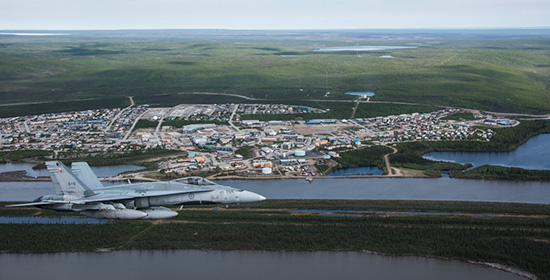
Project Overview
- Location: Whitehorse (YT), Resolute (NU), Cambridge Bay (NU), Rankin Inlet (NU)
- Type: Defence logistics infrastructure
- Investment: $2.67 billion CAD
- Proponent: Department of National Defence, Government of Canada
- Status: Planned; announced March 2026
- Indigenous involvement: Consultation with Yukon First Nations and Inuit associations
Executive Summary
A $2.67 billion network of two Northern Operational Support Hubs (Whitehorse and Resolute) and two Northern Operational Support Nodes (Cambridge Bay and Rankin Inlet), announced alongside the Forward Operating Locations package in March 2026. Where the FOLs are about projecting force, the NOSHs and NOSNs are about sustaining it: pre-positioned fuel, equipment, and personnel that let the CAF respond anywhere in the Arctic year-round without staging from southern Canada. Smaller capital envelope than the FOLs, but a cleaner, more focused scope and a similarly supportive Indigenous and political environment.
What's being built
Two tiers of facility. The Hubs at Whitehorse and Resolute are larger sustainment sites — fuel storage, equipment depots, accommodations, and the ability to receive and process inbound personnel and materiel at scale. The Nodes at Cambridge Bay and Rankin Inlet are smaller forward staging points that extend reach further into the Kitikmeot and Kivalliq regions. Together they form a logistics spine that lets a deploying force jump from Whitehorse or Resolute to a Node and then onward, rather than running every operation from Edmonton or Trenton.
Resolute and Cambridge Bay are particularly significant: Resolute already hosts the Canadian Armed Forces Arctic Training Centre, and Cambridge Bay is home to the Canadian High Arctic Research Station, so both have existing federal footprints to build on.
Indigenous context
The four sites touch the Kwanlin Dün First Nation and Ta'an Kwäch'än Council in Whitehorse, the Qikiqtani Inuit Association at Resolute, the Kitikmeot Inuit Association at Cambridge Bay, and the Kivalliq Inuit Association at Rankin Inlet. All four regions have established Indigenous development corporations with track records of partnering on federal infrastructure — the same organisations involved in Grays Bay, the Kivalliq Hydro-Fibre Link, and the FOL package. Local employment and procurement are explicit federal objectives.
Why investors should pay attention
The work is logistics-heavy rather than complex airfield construction, the four sites are geographically dispersed (which favours specialised regional contractors and modular approaches), and the operational case is straightforward enough that scope creep risk is lower.
---CS-1.jpg?width=352&name=ENERGY---NORTHWEST-COAST-OIL-PIPELINE-(ALBERTA-TO-BC)---CS-1.jpg)